Estate agent commission: what you pay and what you get
 Written and reviewed by Bc. Petr Kučera, MSc., MBA
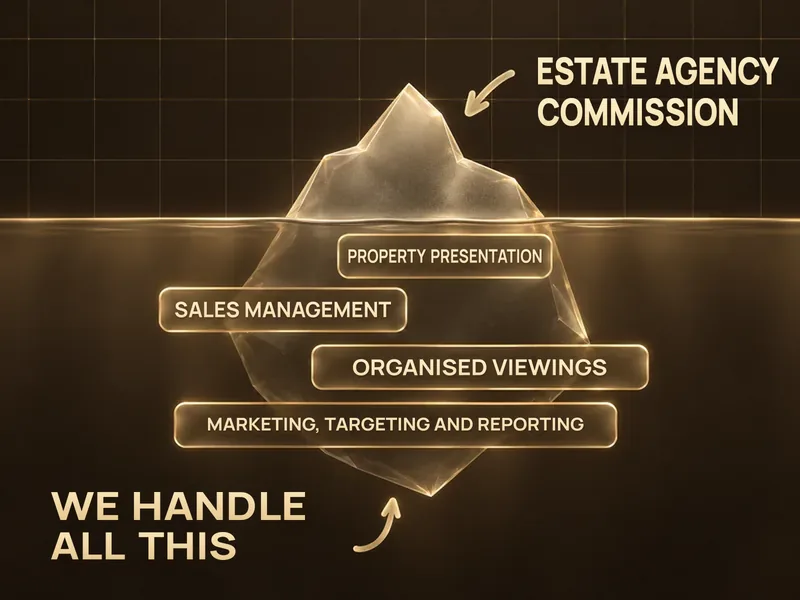
No law sets the amount of an estate agency’s commission. The brokerage agreement must state either the commission itself or the method used to calculate it. Industry sources give indicative figures in single-digit percentages of the purchase price, such as 3 to 5% or 3 to 6%. Each range comes from a different author. For most of them, you also need to check whether VAT is included.
The percentage itself matters less than it might seem. If a VAT-registered agency quotes its rate excluding VAT, 21% VAT is added to the commission: 3% plus VAT becomes 3.63% of the purchase price. The services vary too. Some offers include legal services and escrow; others charge separately for the energy performance certificate (PENB).
The price lists and legislation cited here were checked on 29 September 2026.
Commission rates quoted by different industry sources
There is no single answer to how much commission an agency charges. Published ranges vary in both their scope and their sources.
What percentage does an agency take on a sale?
- A range of 3 to 6%: Asociace realitních kanceláří ČR (ARK ČR, the Association of Estate Agencies of the Czech Republic) gives this range for ordinary properties ‘according to general market information’ in an undated article on its website. VAT is not mentioned.
- A range of 3 to 5%: according to e15 on 2 March 2026, this has been the range for a long time. The article does not say whether VAT is included.
- A range of 1 to 7%: Miroslav Duda, President of ARK ČR, used this figure to describe the situation at the time at a press conference on 28 July 2026. His statement was reported by Pražský deník and Deník N.
ARK ČR does not survey commission levels, as its secretary general Jaroslav Borůvka told Měšec.cz on 23 March 2026. The ARK ČR advice section mentions a rate only as an example: ‘e.g. 4%’.
A historical survey published by one unnamed agency in 2018 covered 1,700 instructions between April 2017 and April 2018. Within that sample, the average commission in Prague was CZK 131,569.
Why there is no standard commission rate
The Real Estate Brokerage Act (Act No. 39/2020 Coll.) sets no commission rate. However, Section 10(1)(c) requires the brokerage agreement to state the commission or its calculation method. This applies to all clients, not just consumers.
The ARK ČR advice section says that dictating a rate, or even recommending one, would conflict with current legislation. In its view, the price is for the client and the agency to agree between them. Jaroslav Borůvka, secretary general of ARK ČR, gave the same explanation in an interview with FinTag on 13 February 2026. He also said that the Office for the Protection of Competition (ÚOHS) could step in if anyone tried to influence the market.
The available figures therefore remain separate ranges attributed to different authors: 3 to 5%, 3 to 6% and 1 to 7%. For most, you still need to establish whether VAT is included before making a comparison.
Examples of public price lists
These five public price lists, checked on 29 September 2026, give a more concrete picture of individual offers.
| Anonymous example | Quoted rate | Rate including VAT | Other terms |
|---|---|---|---|
| A Prague agency | 3% plus VAT | 3.63%, as stated by the agency itself | States that everything associated with the sale is covered, including marketing, legal services and escrow. |
| Another agency operating in Prague | 3 to 4% of the achieved purchase price plus VAT, depending on location and property type | 3.63 to 4.84% | Seller pays. Entitlement arises when the purchase agreement is concluded; payment falls due after the purchase price has been transferred to the seller. |
| An agency covering Prague and the surrounding area | 3 to 5% plus VAT | 3.63 to 6.05% | Payment falls due only after registration in the Land Register (Cadastre of Real Estate). The agency pays for the price estimate, photographs, floor plan and paid advertising. |
| A Prague estate agent, price list valid from 20 November 2025 | Final rate of 4%, including VAT | 4% | Prague minimum: CZK 180,000. PENB costs an additional CZK 6,000. Arranging submission of the application for registration in the Land Register is included; the administrative fee is excluded. |
| A Plzeň agency, price list effective from 1 January 2026 | Excluding VAT: 4% above CZK 8 million up to CZK 14 million; 3.5% above CZK 14 million up to CZK 20 million; 3% above CZK 20 million | Respectively 4.84%, 4.235% and 3.63% | Seller pays for PENB. |
To turn a rate quoted excluding VAT into the final rate, multiply it by 1.21.
How VAT changes the final commission: 3% is not always 3%
In 2026, the standard VAT rate is 21%. It applies to services unless legislation provides an exception, under Act No. 235/2004 Coll., Section 47(1)(a) and (4). An agency charges VAT on its commission only if it is VAT-registered; not every agency is.
Under Section 6(1) and (2) of Act No. 235/2004 Coll., a business whose domestic turnover exceeds CZK 2,000,000 in a calendar year becomes a VAT payer from 1 January of the following year. If its domestic turnover exceeds CZK 2,536,500 within a year, it becomes a payer from the day after the threshold is crossed. This is one reason why some agencies do not charge VAT.
For a VAT-registered agency, 3% plus VAT is 3.63%: 3% × 1.21. Likewise, 4% plus VAT becomes 4.84%, and 5% plus VAT becomes 6.05%. Comparing 3% excluding VAT with 4% including VAT therefore means comparing final rates of 3.63% and 4%. At a purchase price of CZK 8,000,000, the respective costs are CZK 290,400 and CZK 320,000.
Three different kinds of commission information are often mixed together:
- Indicative industry ranges, such as 3 to 6%.
- Legal rules, such as the rule that commission falls due no earlier than the day the purchase agreement is concluded.
- An individual price list, for example one where payment is due after registration in the Land Register. That condition comes from the contract, not the law.
A quoted ‘3%’ can mean a final 3%, or a base of 3% before VAT is added.
Before contracting with a consumer, a business must disclose the total service price, including all taxes and charges, sufficiently in advance. If that price cannot reasonably be determined beforehand, it must explain the calculation method. This follows from the Civil Code (Act No. 89/2012 Coll.), Section 1811(2)(c). We recommend asking for the final amount in CZK, including any VAT, at a specified purchase price.
What commission costs in CZK when selling a flat
Commission is usually calculated as a percentage of the purchase price. If a VAT-registered agency quotes its rate excluding VAT, multiply the result by 1.21. With an unchanged percentage, the CZK amount rises as the purchase price increases. How much you pay depends mainly on your flat’s purchase price. We explain how to estimate it on our price estimate page.
| Purchase price | Commission at 3% plus VAT | Final commission at 4% including VAT | Commission at 5% plus VAT |
|---|---|---|---|
| CZK 8,000,000 | CZK 290,400 | CZK 320,000 | CZK 484,000 |
| CZK 15,000,000 | CZK 544,500 | CZK 600,000 | CZK 907,500 |
| CZK 30,000,000 | CZK 1,089,000 | CZK 1,200,000 | CZK 1,815,000 |
Each figure is the purchase price multiplied by the rate. Where the rate excludes VAT, the result is multiplied by 1.21 as well. The three rates come from the public price lists above: 3% plus VAT, 4% including VAT, and 5% plus VAT as the upper limit. None of them is tied to a particular price level.
An editorial example in e15 on 2 March 2026 illustrated this using a flat in Strašnice and commission of approximately 5%. Between February 2023 and March 2026, the commission rose from around CZK 530,000 to CZK 800,000.
Higher-priced properties sometimes carry a lower rate
Some agencies reduce their percentage for more expensive properties. The Plzeň agency above quotes, excluding VAT, 4% above CZK 8 million up to CZK 14 million, 3.5% above CZK 14 million up to CZK 20 million, and 3% above CZK 20 million. Other agencies publish differing descriptions of ‘usual’ rates by property price band.
The arithmetic is straightforward: an unchanged percentage produces a higher CZK commission when the purchase price rises.
Minimum commission
Some agencies set a minimum commission for cheaper properties. One unnamed agency quotes an approximate minimum of CZK 50,000 for properties up to CZK 1 million. For properties priced from CZK 1 to 3 million, it quotes 5%, with an approximate minimum of CZK 80,000. All these figures exclude VAT.
For a flat sold at CZK 8,000,000, commission of 4% is CZK 320,000. That exceeds the CZK 180,000 minimum quoted by the Prague estate agent in the table, so the minimum would not increase the commission in this example.
What commission covers and what costs extra
Under the Real Estate Brokerage Act, Section 3(1), brokerage always involves finding a counterparty interested in entering into a purchase agreement. Section 3(2) says it ‘usually’ also includes the following activities:
- Advertising.
- Assessing the property’s condition and recommending an asking price.
- Marketing.
- Arranging viewings.
- Obtaining construction and technical documentation.
- Arranging legal services.
- Arranging escrow of funds.
The word ‘usually’ matters. None of these additional items is automatically included in every commission; the agency’s agreement and price list determine the scope.
The price lists above show the differences. One states that everything is included, including legal services and escrow. Another says the agency pays for the price estimate, photographs, floor plan and paid advertising. A third charges separately for PENB and excludes the Land Register administrative fee. Another leaves the cost of PENB to the seller.
Escrow of the purchase price has its own rules under Section 4 of the Real Estate Brokerage Act. An agency must not actively offer to hold escrow itself. It may arrange escrow only with a bank, notary or lawyer, or with a judicial enforcement officer only in connection with proceedings. Agency-held escrow requires the client’s written request in a separate document, a separate account, record-keeping and cashless transactions. The purpose is to keep the buyer’s money separate from the agency because of the risk of misuse. The standard providers are a bank, notary or lawyer. You can read more about escrow, and about how escrow ties in with registration in the Land Register, in our guide to selling a flat in Prague.
Who pays the commission: seller or buyer?
The Real Estate Brokerage Act does not say who must pay commission. Section 12(3) allows the agency to agree a fee with the other party as well.
In the sale price lists cited here, the seller pays. One states ‘the seller pays the commission’; another says ‘the seller usually pays the commission’.
What ‘commission-free’ means
If the buyer formally pays commission, it increases their total expenditure on the property. Removing the seller’s direct payment does not remove the agency’s remuneration. Agencies and an online platform critical of agencies describe the same distinction.
Since the start of 2026, one unnamed online platform has offered an assisted sale for 1.5% plus VAT. The service is narrower, because the owner conducts the property viewings themselves. The platform presents the service as ‘without an estate agency’ and ‘without commission’. ARK ČR referred this presentation to the Czech Trade Inspection Authority (ČOI), and ČOI began looking into the service. This was reported by e15 on 18 August 2026 and Pražský deník on 29 July 2026.
Commission from both sides
If an agency also agrees commission with the counterparty for the same property, it must tell its client the amount or how it is determined, no later than when the brokerage agreement is concluded. Under Section 12(3) and (4), failure to provide this information gives the client a right to withdraw.
The Real Estate Brokerage Act contains no express prohibition on commission from both sides, but it imposes this disclosure duty. Disclosure alone does not establish that the arrangement is legally sound in every respect. Other issues, including conflicts of interest, require separate assessment.
Entitlement to commission and when payment is due
Commission normally falls due no earlier than the day the purchase agreement is concluded. An earlier due date requires an express notice in the brokerage agreement, and commission can fall due only once the agency has secured an opportunity to enter into the purchase agreement. These rules appear in the Real Estate Brokerage Act, Section 19(1) and (2).
Some agencies agree later payment, such as after the purchase price reaches the seller’s account or registration in the Land Register is completed. These are contractual arrangements, not statutory requirements. One agency in the table also states that entitlement to commission arises when the purchase agreement is concluded.
Under Section 19(3), an advance agreed with a consumer cannot exceed two thirds of the agreed commission. This caps the advance, not the final commission.
Section 19(4) denies an agency entitlement to commission from a consumer where, because of the agency’s inactivity, errors or insufficient cooperation, the purchase agreement is concluded only after the brokerage agreement has ended.
A Supreme Court ruling shows the opposite situation (33 Cdo 2339/2025 of 21 July 2026). An exclusivity period agreed with a consumer went beyond the statutory limit, but this did not in itself make the whole agreement invalid. The court simply disregarded the provision that deviated from the law. It awarded the agency commission of 4.5%, which came to CZK 245,250. The deciding fact was that the buyer had been found while the agreement was still in force, even though the purchase agreement was signed later, after it ended. This was a single dispute, and it concerned properties in the Zlín Region.
Our guide to selling a flat in Prague explains how the purchase agreement, transfer of funds and registration in the Land Register fit together.
How the agreement must deal with commission
The brokerage agreement must state the commission or how it is determined, so you know your payment obligation before signing. If both are missing, the agreement is invalid. Under Section 10(3), only the client may invoke that invalidity.
Other contractual rules also affect commission, directly or indirectly:
- A written agreement in a separate document: the brokerage agreement must be in writing under Section 9(2), and under Section 15 it must not share a document with the purchase agreement. Only the client can argue that the agreement is invalid. Commission agreed only verbally does not give you the same rights.
- No obligation to go through with the sale: Section 14 protects a client who is a consumer from any obligation to conclude a purchase agreement. In 33 Cdo 1507/2022 of 20 June 2023, the Supreme Court held that such an obligation is to be disregarded. A contractual penalty for breaching it is not permitted, and a reservation fee the agency had kept had to be returned as unjust enrichment. That dispute involved buyers, but the protection under Section 14 applies to any client who is a consumer.
- Exclusivity of no more than 6 months: with a consumer, exclusivity can be agreed only for a fixed period of up to 6 months. It can be extended repeatedly, but each extension can be agreed no earlier than 30 days before the period ends (Section 17(4)). Non-exclusive agreements are not subject to this cap. The purpose is to protect consumers from being tied to one agency for a long time. A provision that goes beyond the limit has no effect, but the rest of the agreement stays valid, as in 33 Cdo 2339/2025.
- Notice period: a consumer agreement made for an indefinite period can have a notice period of no more than 1 month (Section 18).
- No bills of exchange or cheques: neither may be used to secure obligations under a brokerage agreement (Section 16).
All the provisions above come from Act No. 39/2020 Coll. They refer to the current version in force from 1 July 2021, as amended by Act No. 190/2020 Coll., Act No. 527/2020 Coll. and Act No. 249/2021 Coll. The official text is available in the e-Sbírka collection of laws. You can also read what you commit to when you sign with an agency, with more detail on the content of the brokerage agreement and on exclusivity.
Commission and agent incentives
Percentage-based pay can create a conflict of interest. The extra work and time needed to get a higher price fall on the agent, but the agent keeps only a small share of the increase. That may give the agent a reason to sell faster than the owner would if selling alone. Studies from the United States describe this mechanism.
- USA, 2005: Levitt and Syverson, NBER Working Paper 11053, January 2005 (full text of the study). The study looked at almost 100,000 sales in suburban Cook County near Chicago between 1992 and 2002. Homes owned by estate agents themselves sold for about 3.7% more than comparable client homes and stayed on the market about 9.5 days longer. The authors’ explanation is that the agent receives about 1.5% of each extra dollar, with a typical total US commission of 6%.
- USA, 2008: Levitt and Syverson, Brookings-Wharton, January 2008, covering Cook County, Sacramento and Santa Cruz. Homes offered through agents charging a flat fee took longer to sell but achieved similar prices, with sellers saving more than USD 5,000 on average. The authors link this result to the US multiple listing service (MLS), which does not exist in the Czech Republic.
- USA, 2017: Barwick, Pathak and Wong, American Economic Journal: Applied Economics, 2017. The study covered 653,475 listings in eastern Massachusetts between 1998 and 2011. A lower commission for the buyer’s agent was linked to a 5% lower probability of sale and a 12% longer time to sell. The study concerns the buyer’s agent, not the agent acting for the seller.
In the US studies, split commission and the MLS are part of how the local market works. What carries over to Prague is the incentive mechanism. The size of the effects found does not simply carry over, because it depends on the US setting.
An agent’s motivation also depends on how the fee is structured. It can be a percentage, a fixed amount, or a bonus for beating an agreed price. The Plzeň agency in our overview charges a fee on the base price according to its rate scale, plus 30% of any amount above it, and this 30% already includes VAT. Another industry website describes a percentage fee topped up with a bonus for exceeding the agreed price.
How to compare offers from estate agencies
We recommend discussing commission before signing the brokerage agreement. The agreement must state the amount or its calculation method, and any commission agreed with the counterparty must be disclosed no later than its conclusion. Check the basis for calculating commission in each offer. The price lists here use the purchase price, but the requirement to specify the calculation method makes this a point to verify in every offer.
Twelve checks to make before you sign
- Commission amount or a precisely defined calculation: if the agreement has neither, it is invalid.
- What the commission is calculated on: check whether it is the purchase price actually achieved.
- VAT: is the agency registered for VAT, and what is the total fee in CZK including any VAT?
- When payment is due: before the purchase agreement is concluded only with an express notice in the agreement, and never before the agency has secured an opportunity to conclude the purchase agreement.
- Advance payment: if one is agreed with a consumer, it is capped at two thirds of the commission.
- Exclusivity and ending the agreement: with a consumer, exclusivity lasts no more than 6 months, and an extension can be agreed no earlier than 30 days before it ends. A consumer agreement for an indefinite period can have a notice period of no more than 1 month.
- Commission after the agreement ends: check when entitlement to commission could arise even after the agreement has ended.
- Commission from the buyer: find out whether commission has been agreed with the other party, and how much it is.
- Included and extra costs: in particular the PENB, the Land Register fee, legal services and escrow.
- Escrow provider: the standard options are a bank, a notary or a lawyer.
- No forced sale: a consumer cannot be charged a contractual penalty for not concluding a purchase agreement, and no bills of exchange or cheques may be used.
- Written form and a separate document: keep the brokerage agreement separate from the purchase agreement.
Questions for the agent
- How much will I pay in CZK in total, including VAT, if the purchase price is X?
- What price is the commission calculated on, and when is it payable?
- What exactly does the commission cover, and what other costs will I have?
- Will you also take commission from the buyer?
- How long do you want exclusivity for, and what happens if I do not give notice?
- Where will the purchase price be held in escrow?
- What exactly will you do to get the best possible price for my flat?
The last question tests the actual scope of the service, which the law describes with the qualifier ‘usually’. If awards and rankings also inform your choice, read our guide to assessing estate agency rankings critically.
Common commission misconceptions
| Misconception | Explanation |
|---|---|
| The law or the association sets the rate. | The client and agency agree it. Neither the law nor ARK ČR sets the rate. |
| The usual commission is 5% (or 3%). | Industry sources give different ranges: 3 to 5%, 3 to 6%, and, according to the ARK ČR president, 1 to 7%. |
| A quoted 3% is always the final rate. | A VAT-registered agency adds 21% VAT to a rate quoted excluding tax. Thus 3% plus VAT is 3.63% of the purchase price. Check whether VAT is included. |
| Commission automatically covers everything. | The price list matters. Some include legal services and escrow; others charge separately for PENB and exclude the Land Register administrative fee. |
| Buyer-paid commission has no economic effect. | The remuneration is still paid within the transaction, increasing the buyer’s total property expenditure. |
| The law makes commission payable only after registration in the Land Register. | The default earliest date is conclusion of the purchase agreement. Earlier payment requires express contractual notice and cannot precede securing an opportunity to conclude it. Some agencies contractually defer payment. |
| An agency may take the whole commission in advance. | An advance agreed with a consumer is capped at two thirds of the commission. |
| Consumer exclusivity can run for a year. | The maximum is 6 months, with repeated extensions permitted. An extension cannot be agreed earlier than 30 days before expiry. An excessive term is disregarded while the rest of the agreement remains valid. |
| Commission always disappears when the agreement ends. | Entitlement may still arise where the agency found the buyer while the agreement was in force. A consumer exception applies where the agency’s inactivity, errors or insufficient cooperation caused the purchase agreement to be concluded only after expiry. |
| Commission from both sides is always unlawful. | The agency must disclose the amount of the other party’s commission, or the method for setting it. If it fails to do so, the client can withdraw. |
| A higher fee always brings a higher sale price. | The US studies above look at how the fee model relates to agents’ incentives. |
| The agency can freely use its own account for escrow. | Escrow has its own legal regime. The standard providers are a bank, a notary or a lawyer. The agency itself can hold the money only at the client’s written request and under strict conditions. |
GATSBYS commission
We are a Prague estate agency, and in a sale we represent the seller. We work only in Prague, selling flats priced from CZK 8 million as well as villas. Our commission is 3.99% of the purchase price. GATSBYS is not registered for VAT, so nothing is added to that figure. The percentage is fixed, while the amount in CZK depends on the purchase price. We take no commission from the buyer. Our exclusive brokerage agreement with the seller runs for 3 months and can be extended if both sides agree.
Our commission includes:
- Data to inform pricing and risk assessment.
- Property presentation, including copy, photographs and a floor plan.
- A marketing campaign covering media planning, creative materials, targeting and performance reporting, with a paid advertising budget of CZK 50,000 included.
- Management of the sales process and communication with prospective buyers.
- Structured management of viewings.
- Negotiation of the transaction’s contractual terms.
- Coordination with a law firm.
You can find out more about how we handle a sale and about selling your flat or villa with GATSBYS.
Frequently asked questions
What percentage do estate agencies charge on a flat sale?
There is no single fixed or statutory rate. The agreement must state the commission or how it is determined. Industry figures include 3 to 5% from e15, 3 to 6% from ARK ČR and 1 to 7% from its president. Public price lists checked on 29 September 2026 included 3% plus VAT, 3 to 4% plus VAT, 3 to 5% plus VAT and a final 4% including VAT. Another used declining rates of 4%, 3.5% and 3%, depending on price, all excluding VAT.
Does the commission already include VAT?
It depends on whether the agency is registered for VAT. If it is, 21% is added to a rate quoted before tax, so 3% plus VAT comes to 3.63% of the purchase price. Some agencies do not charge VAT at all. A price list may show a base rate plus VAT, or a final price such as 4% including VAT. When you compare offers, always ask whether VAT is included.
Who pays commission: the seller or the buyer?
The law does not designate a single payer and also envisages commission agreed with both parties. In the sale price lists cited here, the seller pays. If the buyer formally pays instead, it forms part of their total property expenditure; the agency’s remuneration does not disappear.
What is included in commission, and what costs extra?
By law, brokerage always includes finding an interested buyer. It ‘usually’ also includes advertising, assessing condition and recommending an asking price, marketing, viewings, obtaining construction and technical documentation, and arranging legal services and escrow. The agreement and price list determine actual coverage. Some include legal services and escrow; others charge separately for PENB and exclude the Land Register administrative fee.
When is commission payable?
The default earliest date is conclusion of the purchase agreement. Earlier payment requires express contractual notice and cannot precede securing an opportunity to conclude that agreement. Some agencies contractually defer payment until the purchase price is transferred or registration in the Land Register is completed. An advance agreed with a consumer cannot exceed two thirds of the agreed commission.
Can commission still be due after the agreement ends?
It depends on the circumstances. A consumer does not have to pay commission if, because of the agency’s inactivity, errors or insufficient cooperation, the purchase agreement was concluded only after the agreement with the agency had ended. The Supreme Court ruling 33 Cdo 2339/2025 shows the opposite case. There, the agency was awarded commission because the buyer had been found while the agreement was in force, even though the purchase agreement was signed after it ended.
How long can an exclusive agreement last?
Consumer exclusivity must be for a fixed term of no more than 6 months. Repeated extensions are allowed, but cannot be agreed earlier than 30 days before expiry. For an indefinite consumer agreement, the notice period cannot exceed 1 month.
Can an agency also take commission from the buyer?
The law does not expressly prohibit commission from both sides. However, the agent must tell you how much commission they will receive from the other party, or how it will be determined, no later than the conclusion of the brokerage agreement. If they fail to do so, you can withdraw from the agreement.
How do I calculate the commission?
The basic formula is purchase price × rate. If the rate is quoted plus VAT, multiply the result by 1.21 as well. The three rates used here are 3% plus VAT, a final 4% including VAT, and 5% plus VAT. On a purchase price of CZK 8,000,000, they give CZK 290,400, CZK 320,000 and CZK 484,000. On CZK 15,000,000, they give CZK 544,500, CZK 600,000 and CZK 907,500. On CZK 30,000,000, they give CZK 1,089,000, CZK 1,200,000 and CZK 1,815,000.
Can the commission rate be negotiated?
Commission is a matter for agreement with the agency. The law sets no rate, but the agreement must state the amount or how it is determined. ARK ČR’s position is that prescribing or recommending a particular rate would breach current legislation.
Considering selling a flat or villa in Prague? Get in touch.
Request a sale assessment founder of GATSBYS
Selected for you
-

| Petr Kučera
Selling a flat in Prague
Selling a flat in Prague, from preparing documents to receiving payment: Land Register, escrow, PENB, SVJ confirmation, mortgage, tax and cooperative flats.
Read -

| Petr Kučera
Buy-to-let flat in Prague: yield, financing and what to check before you buy
Prague buy-to-let flats: gross yields from public data, how to work out your own net yield, CNB investment mortgage limits, tax and checks before you buy.
Read -

| Petr Kučera
Realitka roku: how to use the ranking when choosing an agency
Learn what Realitka roku and Realiťák roku measure, how branch and agent rankings are calculated and how to use them as one factor when choosing an agency.
Read