Selling a flat in Prague
 Written and reviewed by Bc. Petr Kučera, MSc., MBA
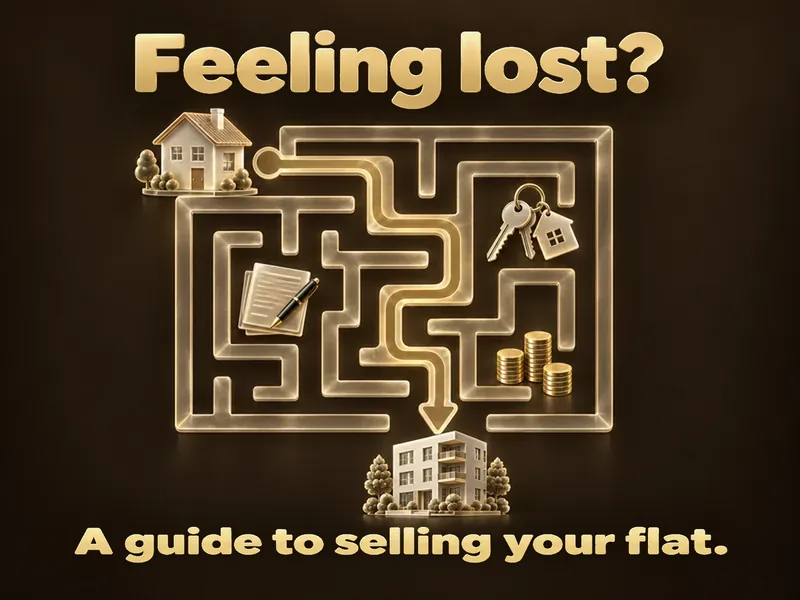
Selling a flat follows a fixed sequence of steps: preparing documents and estimating the price, marketing the flat, choosing a buyer, signing the purchase agreement, applying for registration and receiving payment. Ownership passes through registration in the Land Register (Cadastre of Real Estate), under Section 1105 of the Civil Code (Act No. 89/2012 Coll.). Signing the purchase agreement does not make the buyer the owner. Registration cannot be approved until 20 days after notice is sent to the owner, under Section 18 of the Cadastral Act (Act No. 256/2013 Coll.).
Signing and registration happen at different times. A notary, lawyer or bank can hold the purchase price in escrow during that interval. The money is released to you under the conditions set in the escrow agreement. The Notarial Chamber of the Czech Republic describes a notarial process in which payment follows completed registration.
Two statutory duties concern your paperwork, subject to the energy certificate exceptions explained below. Request an energy performance certificate (PENB), show it to prospective buyers and hand it to the buyer under Section 7a of the Energy Management Act (Act No. 406/2000 Coll.). Provide the buyer with confirmation of unit-related debts from the owners’ association (SVJ) or building manager under Section 1186 of the Civil Code.
The legal provisions and figures in this guide are stated as at 30 September 2026.
Selling a Prague flat: from deciding to sell to receiving payment
The steps below apply to a flat in direct ownership, meaning a unit registered in the Land Register. A cooperative flat is transferred and taxed differently, so we cover it in a separate chapter later on.
- Establish what you are selling and your circumstances. Are you selling a unit or a cooperative share? Identify every owner, any mortgage, how long you have lived there and when you acquired it. These affect both the transfer and tax.
- Get the documents ready before the listing goes live. Ask the SVJ or building manager in writing for the PENB. They have 30 days to hand it over if a certificate already exists and 60 days if one still has to be obtained (Section 7a(2)(f)). Request the confirmation of debts as well. If there is a mortgage, tell the bank that you intend to repay early. The bank must then provide a redemption statement under Section 117(6) of the Consumer Credit Act (Act No. 257/2016 Coll.).
- Set the asking price and launch the listing. Section 7a(3) requires the energy rating class in listings and other advertising, subject to the exceptions explained below. The pricing section uses Prague data to explain why the first asking price matters.
- Choose the buyer. Look at both the price offered and how the buyer will finance it. A reservation agreement made with an estate agency cannot bind a consumer to buy, as the Supreme Court ruled in 33 Cdo 1507/2022.
- Sign the purchase agreement and set up escrow. The agreement must be in writing under Section 560 of the Civil Code. According to the Czech Office for Surveying, Mapping and Cadastre (ČÚZK), the signatures must be officially verified. Set out the conditions for paying out the money in the escrow agreement.
- File the application for registration in the Land Register. The fee is CZK 2,000, paid by whoever files the application (Public Administration Portal). Registration can be approved no earlier than 20 days after notice is sent to the owner. Nationwide, registration took 22 days on average in August 2026 (ČÚZK report of 24 September 2026). Prague’s cadastral office reported an average of 24 days for 2024.
- Receive the purchase price and hand over the flat. The money is paid out under the escrow agreement. The law does not set a specific day (Notarial Chamber of the Czech Republic).
- Complete any subsequent obligations. Depending on your circumstances, these may concern income tax, notification of funds intended for your own housing needs, or a property tax notification by 31 January of the following year. The tax section explains the conditions.
No official or independent Czech source gives a documented typical length for the whole sale. Only individual stages are documented, and we look at them in the chapter on timing.
Common myths about flat sales
| Misconception | What actually applies |
|---|---|
| ‘The transfer is complete once the agreement is signed.’ | Ownership passes on registration in the Land Register (Section 1105 of the Civil Code). |
| ‘Registration always takes exactly 20 days.’ | 20 days is the legal minimum. The national average in August 2026 was 22 days, and in Prague the average for 2024 was 24 days. |
| ‘The protection period starts on the day of filing.’ | It starts when notice is sent to the owner (Sections 18 and 16 of the Cadastral Act). |
| ‘The registration fee is CZK 1,000.’ | The administrative fee is CZK 2,000 (Act No. 634/2004 Coll.). |
| ‘A missing PENB means a CZK 50,000 fine.’ | An individual can be fined up to CZK 200,000. This is only the maximum, and the actual penalty may be lower (Section 12). |
| ‘Every sale needs a PENB.’ | Cultural monuments and buildings in conservation reserves are exempt. A building constructed and last substantially altered before 1 January 1947 needs no PENB if the parties agree on this in writing. |
| ‘You have to pay off the mortgage before you can sell.’ | You can sell. Completing the sale requires the bank’s cooperation, and the bank consents to removal of the lien once the loan is repaid (Česká spořitelna). |
| ‘An early repayment fee cannot be avoided.’ | If you sell at least 24 months after the loan agreement was concluded, the bank cannot claim compensation. A fixed-rate period agreed before 1 September 2024 comes under the new rules only from the next fixed-rate period. |
| ‘Any sale over CZK 5 million must be reported.’ | Exempt income from selling a unit registered in the Czech Land Register is excluded from this reporting. |
| ‘The exemption is capped at CZK 40 million.’ | This cap does not apply to flats. It currently applies only to crypto-assets. |
| ‘Residence for tax purposes means your registered permanent address.’ | Residence for tax purposes means a permanent home where you intend to stay permanently. |
| ‘Selling a cooperative flat works the same way as selling one in direct ownership.’ | A cooperative share is transferred outside the Land Register and is taxed differently. |
Are you selling the flat itself or a share in a housing cooperative?
With a cooperative flat, you transfer a share rather than register ownership of the flat. Under Section 601(2) of the Business Corporations Act (Act No. 90/2012 Coll.), the transfer takes effect in relation to the cooperative when it receives the effective agreement, or both parties’ declaration that they have concluded it, unless the agreement specifies a later effective date.
The lease of the cooperative flat passes to the buyer with the share. So do the transferor’s debts to the cooperative relating to the use of the flat (Section 736(2)). Under Section 601(1), the transferor remains liable as guarantor for debts connected with the share.
Section 736(1) prevents a housing cooperative from restricting or excluding transferability of the share, provided the recipient meets the membership conditions in its statutes.
There is no registration procedure, so no Land Register 20-day protection period applies. Escrow needs a different release condition, such as delivery of the agreement to the cooperative.
| Feature | Personal ownership | Cooperative flat |
|---|---|---|
| What transfers | Ownership of a unit | A share in the housing cooperative |
| When the transfer takes effect | Registration, with legal effects dating back to receipt of the application by the cadastral office | In relation to the cooperative, on receipt of the effective agreement, unless it specifies a later effective date |
| Land Register 20-day protection period | Yes | No registration procedure, so no such period |
| Related debts | Debts to the SVJ transfer if the buyer should and could have discovered them; the seller remains a guarantor | Debts to the cooperative relating to use of the flat transfer; the transferor remains a guarantor |
| Escrow release condition | For notarial escrow, completed registration | A different condition, such as delivery to the cooperative |
| Income tax | Exemptions described in the tax section | A different regime to discuss with a tax adviser |
Sale documents: legal requirements and usual practice
We split the documents into four groups. The first covers what the seller must provide by law. The second covers what is needed for registration in the Land Register. The third applies only to a flat with a mortgage, and the fourth is used for practical checks.
| Group | Document | Related rules |
|---|---|---|
| Seller’s legal obligation | PENB | Subject to the exceptions described below, request it from the SVJ or building manager and show it to interested buyers before any agreements on the purchase are concluded. Hand it over no later than when the purchase agreement is signed, and state the rating class in the listing (Section 7a(3)). |
| Seller’s legal obligation | Confirmation from the SVJ or building manager | Debts for contributions to building management and services, or confirmation that there are none (Section 1186 of the Civil Code) |
| Needed for registration in the Land Register | Purchase agreement | Written form under Section 560 of the Civil Code and verified signatures according to ČÚZK |
| Needed for registration in the Land Register | Application for registration | The original agreement or a certified copy is attached. According to ČÚZK, the fee of CZK 2,000 is paid by the applicant. |
| Mortgage only | Redemption statement and consent to removal of the lien | The bank must provide the statement once you give notice of early repayment (Section 117(6)). In the practice described by Česká spořitelna, the bank gives its consent after repayment. |
| Practice and checks | Title deed extract (list vlastnictví), acquisition title, owner’s declaration, SVJ articles, handover protocol | These are not listed attachments to the application. The attachments are the agreement and, where relevant, a geometric plan or a power of attorney with a verified signature (Public Administration Portal). |
Energy performance certificate (PENB)
Subject to the exceptions below, Section 7a(3) of the Energy Management Act, in the version in force from 1 August 2026, requires the selling owner to:
- Request the PENB from the SVJ or building manager and keep proof of your request.
- Show the certificate or a copy to interested buyers before any agreements relating to the purchase are concluded.
- Hand the certificate to the buyer no later than when the purchase agreement is signed.
- State the energy rating class in the listing and in any other information and advertising materials.
If you sell through an estate agent, give the agent the graphic part of the PENB. Without it, the agent has to advertise the flat with the worst energy rating class.
Request the PENB early. Under Section 7a(2)(f), the SVJ or building manager has 30 days to supply an existing certificate, or 60 days if one must be obtained. You need the class when the listing goes live.
If you do not receive the certificate. If the SVJ does not provide the PENB even after a written request, you can use the flat’s electricity, gas and heat bills for the previous 3 years instead. In that case, you as the seller do not have to state the rating class in the listing (Section 7a(7)).
Possible penalties. An individual owning a flat who breaches Section 7a(3) or (7) may face a fine of up to CZK 200,000 under Section 12(1)(i) and (2)(a), in the version in force from 1 August 2026. This is the maximum, rather than an automatic fine.
A Prague exception linked to the conservation reserve. The PENB obligations on sale do not apply to cultural monuments or to buildings inside a heritage conservation reserve (Section 7a(5)). The government declared the Prague Heritage Reserve (Pražská památková rezervace) in 1971. It covers all of Prague 1, part of Prague 2 and smaller parts of Prague 4, 5, 6, 7 and 8. By cadastral area, it includes Staré Město, Josefov, Malá Strana, Hradčany, Nové Město and Vyšehrad, along with parts of Vinohrady, Holešovice, Podolí, Nusle and Smíchov. The law refers to a reserve, not a heritage zone. Always check the specific building.
Older buildings. Section 7a(10) allows a sale without obtaining a PENB if the parties agree in writing and both construction and the last substantial alteration occurred before 1 January 1947.
Certificate validity. Under Section 7a(4), a PENB lasts 10 years from issue, ending earlier upon a substantial building alteration or a change to heating, cooling or hot-water preparation. An existing certificate may therefore suffice.
PENB checklist:
- Ask the SVJ or building manager in writing.
- Keep track of whichever deadline applies, 30 days or 60 days.
- State the rating class in the listing. If an agent is selling for you, give the agent the graphic part.
- Before any agreements are concluded, make the certificate or a copy available to interested buyers.
- Hand it to the buyer no later than at signing.
- Check whether the building is a cultural monument or lies in the reserve. Also check whether it was both constructed and last substantially altered before 1 January 1947, in which case a written agreement between the parties is also needed.
- If your written request is not met, use the energy bills for the previous 3 years instead.
SVJ confirmation of debts
Under Section 1186(2) and (3) of the Civil Code, you must give the buyer confirmation from the SVJ or building manager of debts for contributions to building management and services, or confirmation that none exist.
The confirmation protects both sides. The debts it covers pass to the buyer if the buyer should and could have found out about them, and the seller is liable for them as guarantor. If the confirmation is not issued without undue delay, the buyer is presumed to have had no way of finding out about the debts.
Pricing and the first weeks of marketing
We explain how to set the price in detail in our guide to estimating the value of a flat. This section focuses on why the first asking price matters.
According to the Valuo infographic, Prague flats in 2023 sold on average 7.62% (CZK 579,206) below their first asking price and 2.23% (CZK 165,397) below their last asking price. The data set covers more than 38,000 listings since 2020 with a known listing history and achieved price.
In Valuo’s Prague data for 2023, most of the gap between the first asking price and the completed sale price was associated with reductions during marketing, averaging CZK 413,809.
Your listing also needs the energy rating class, unless an exception applies or you have replaced the certificate with energy bills. Our page on how we sell at GATSBYS explains how we launch a listing.
Reservations and choosing a buyer
In 33 Cdo 1507/2022 of 20 June 2023, the Supreme Court considered a reservation agreement between an estate agency and a prospective buyer and classified it as real estate brokerage. A consumer cannot be obliged to buy, nor charged a contractual penalty if the purchase does not go ahead. In that case, the agency had to refund a reservation fee of CZK 72,600, as Hypoindex reported.
A reservation agreement made through an estate agency therefore does not oblige a consumer buyer to complete the purchase. Check the buyer’s funding as well as the price they offer. The agreement should address what happens if the buyer cannot obtain funding.
The purchase agreement and escrow
Required form. A flat’s purchase agreement must be in writing. Section 560 of the Civil Code applies this requirement to legal acts transferring a right in rem over immovable property.
Official verification of signatures. According to ČÚZK, an agreement used for registration in the Land Register must carry verified signatures. The original agreement or an officially certified copy is attached to the application.
Escrow. You can use a notary, lawyer or bank.
| Type of escrow | How it works | Key limitation |
|---|---|---|
| Notarial | The buyer pays the money into an escrow account. The notary submits the application for registration and pays the seller once ownership is registered (Notarial Chamber of the Czech Republic). | The agreement determines when the money is released. |
| Lawyer’s | Recorded in the Electronic Escrow Register (Elektronická kniha úschov) of the Czech Bar Association (ČAK) | The ČAK guarantee fund covers losses from a lawyer’s criminal offence only up to a set limit (see below). |
| Bank | For example, at Komerční banka, the money is paid to the seller or returned to the buyer once the agreed documents are presented and the agreed conditions are met. | The agreement sets both the documents and the conditions. |
For all three arrangements, the agreement determines payment timing. The law sets no specific day on which you must receive the money.
The ČAK guarantee fund. From 2026, a client who suffers loss caused by a lawyer’s criminal offence connected with escrow can claim compensation of up to CZK 2.5 million from the ČAK guarantee fund. According to ČAK, where the escrow holds the price of a property used for housing, the limit is up to CZK 5 million per escrow. For flats priced from CZK 8 million, the maximum cover of CZK 5 million does not reach the full price. The fund also covers only the criminal conduct described above.
Registration in the Land Register, the protection period and payment
When the buyer acquires ownership. Under Section 1105 of the Civil Code, a registered unit passes to the buyer only through registration. Signing is insufficient. Once completed, registration has legal effects dating back to receipt of the application by the office under Section 10 of the Cadastral Act. Approval comes later than submission.
The protection period. Section 18(1) prevents approval until 20 days have elapsed after notice is sent to the owner. Under Section 16(1), notice that the property has been flagged as affected by a pending change must be sent no later than the day after the flag is entered, by post, data box or the change-monitoring service. The period therefore does not start when the application is submitted.
Withdrawal requires everyone’s consent. Once registration proceedings have started, Section 16(2) requires all participants to consent to their termination. One participant cannot withdraw the application unilaterally.
Administrative fee. An application costs CZK 2,000 under Act No. 634/2004 Coll., Schedule, item 120(a), in the version in force from 1 September 2026. The Public Administration Portal identifies the applicant as the person liable to pay.
Recorded registration times. The ČÚZK report of 24 September 2026 gives a Czech Republic average of 22 days for completing registration in August 2026, unchanged from August 2025, with 65,171 applications submitted in August 2026. Prague’s cadastral office averaged 24 days in 2024, issued over 95.2% of decisions within 30 days and received 78,659 filings that year. Those figures come from its response of 15 July 2025 under Act No. 106/1999 Coll.
From application to payment:
- The application reaches the cadastral office. The later registration takes legal effect from this moment.
- The office notifies the owner no later than the day after it flags the pending change.
- A minimum of 20 days runs from the date the notice is sent.
- Registration is approved and entered in the Land Register.
- The money is paid out of escrow as the agreement provides. With a notary, this happens only after the registration has been made.
Selling a mortgaged flat
You can sell a flat with a mortgage. In the process described by Česká spořitelna, completion requires the bank’s cooperation: it calculates the balance for a specific date and, after repayment, consents to removal of the lien. Settlement commonly uses lawyer’s or bank escrow. This describes the bank’s practice; the statutory duties follow below.
Information the bank must provide. Once you tell the bank that you intend to repay early, it must give you certain information without undue delay. This covers the principal, the interest and other costs, and an estimate of any compensation it will claim along with the assumptions behind the calculation. It must also set out the situations in which it cannot claim compensation (Section 117(6) of the Consumer Credit Act).
What the bank may claim. Section 117(2) limits compensation for early repayment to costs reasonably incurred.
When compensation is prohibited. Section 117(3)(c), (d), (e) and (h), effective from 1 September 2024, covers these cases, subject to the transitional rules below:
- A sale after at least 24 months from conclusion of the loan agreement, including a cooperative share transfer.
- Repayment outside a fixed-rate period.
- Repayment within 3 months of notification of a new interest rate.
- Repayment of up to 25% of the loan amount during the month before the agreement’s anniversary.
Statutory limits where compensation is permitted. Sections 117(4) and (5) cap it at 0.25% of the amount repaid early for each year, or part-year, remaining in the fixed-rate period, with an overall cap of 1%. It must also stay within both the remaining interest to the end of that period and the reasonably incurred costs determined by law. The administrative component is capped at CZK 1,000 under Section 117a(1)(a). Actual compensation may be lower; the bank supplies the specific estimate.
Earlier fixed-rate arrangements. For a fixed-rate period agreed before 1 September 2024, the new rules apply only from the next fixed-rate period beginning on or after 2 September 2024, according to Czech National Bank (CNB) opinion RS2024-38 of 8 July 2024.
Questions to check before selling with a mortgage:
- When was the loan agreement concluded, and have at least 24 months elapsed?
- When does your fixed-rate period end?
- Was it agreed before 1 September 2024? If so, the new regime applies only from the next fixed-rate period.
- Does the redemption statement match the planned repayment date from escrow? If that date changes, obtain a new statement.
Check the amount of any compensation and the procedure for removing the lien with your own bank.
Which defects must you disclose?
You must disclose defects you know about while negotiating the purchase agreement. Section 2084 of the Civil Code places this duty on the seller.
For a hidden defect in a structure permanently attached to the ground by a fixed foundation, the buyer must raise the defect within 5 years of acquiring the property. If the buyer raises it later and the seller objects that the time limit has passed, the court will not uphold the claim. The seller cannot rely on this objection if the defect stems from a fact the seller knew of, or must have known of, at handover (Section 2129(2)). Five years is therefore not a general warranty on the flat. Equally, it is not true that the seller has no liability at all once the flat is sold.
Tax on the sale and obligations afterwards
This chapter applies to an individual selling a flat in direct ownership that is not part of their business assets. It does not cover tax rates or how to calculate your tax. We recommend having your specific situation assessed by a tax adviser.
Exemption based on residence. An individual’s income from selling a unit is exempt if the seller had their residence there for at least 2 years immediately before the sale. The only ancillary non-residential spaces allowed are a garage, a cellar or a storage room. For community property of spouses, it is enough for one spouse to meet the condition. The exemption does not apply to a flat that is part of business assets (Section 4(1)(a) of the Income Tax Act, Act No. 586/1992 Coll., in the version in force from 1 August 2026; Financial Administration).
What residence means for tax purposes. It means a permanent home, together with circumstances showing that you intend to stay there permanently. A registered permanent address alone does not meet the definition (Section 2(4)).
Exemption based on the holding period test. If you acquired the flat on or after 1 January 2021, more than 10 years must pass between acquisition and sale. If you acquired it on or before 31 December 2020, more than 5 years must pass. If you inherited it from a relative in the direct line or a spouse, the deceased’s period of ownership counts towards yours (Section 4(1)(b); according to the Financial Administration). For more, see the 10-year test for flats acquired from 1 January 2021.
Exemption for money used on your own housing. This option is open to you if you lived in the flat for a shorter time or have not owned it for long enough. The condition is that you use the income to meet your own housing needs. By the tax return deadline for the year in which you received the money, you must notify the tax authority that you received it. This option is excluded if you acquired the flat before 1 January 2021 and did not have your residence there immediately before the sale (Section 4(1)(a) and (b), Section 4b; according to the Financial Administration).
Income tax: a step-by-step check
- Did you have your residence in the flat for at least 2 years immediately before the sale? If yes, the income is exempt. If no, go to step 2.
- Did you own it for more than 10 years (if acquired on or after 1 January 2021) or more than 5 years (if acquired on or before 31 December 2020)? If yes, the income is exempt. If no, go to step 3.
- Will you use the money for your own housing needs? If yes, the income may be exempt, provided you report receiving it by the tax return deadline. This option is excluded if you acquired the flat before 1 January 2021 and did not have your residence there immediately before the sale. If no, none of these exemptions applies, and we recommend consulting a tax adviser.
This decision tree does not apply to a cooperative share. We explain the difference below.
Reporting exempt income over CZK 5 million. Exempt income from selling a unit registered in the Czech Land Register does not have to be reported (Section 38v of the Income Tax Act; Financial Administration information on exempt income). Fines apply only to someone who has a reporting obligation and does not meet it. The fine is 0.1% of the unreported income if you later report it on your own initiative. It is 10% if you report it within an additional deadline set by the tax authority after it asks you to, and 15% if you do not report it even then. The fine can be waived (Section 38w).
The CZK 40 million cap. The CZK 40 million exemption cap does not apply to the sale of a flat. It currently applies only to crypto-assets (Section 4(3) of the Income Tax Act, in the version in force from 1 August 2026).
Property tax notification. If the sale ends your taxpayer status because ownership of all your properties within the same tax administrator’s jurisdiction has changed, notify that administrator by 31 January of the following year. This follows Section 13a(9) of the Property Tax Act (Act No. 338/1992 Coll.).
Cooperative flats. Selling a cooperative share is taxed differently from selling a unit you own. The exemptions and notifications described for a unit registered in the Land Register cannot be applied automatically, and we recommend consulting a tax adviser (Section 4 of the Income Tax Act; Financial Administration).
How long does a Prague flat sale take?
There is no single documented typical figure for the whole process, from the decision to sell to receiving the purchase price. No official or independent Czech source gives this overall time. Only individual stages can be documented.
| Stage | Available information | Source |
|---|---|---|
| Obtaining the PENB | SVJ or building manager: 30 days if a certificate exists, 60 days if one must be obtained | Section 7a(2)(f) |
| Portal-reported selling time | Prague flat in the spring 2026 season: 122 days, 24 days faster year on year | Reas, 20 May 2026 |
| Land Register protection period | At least 20 days from dispatch of notice to the owner | Section 18(1) |
| Registration nationwide | August 2026: average 22 days | ČÚZK |
| Registration in Prague | 2024: average 24 days; over 95.2% of decisions within 30 days | Cadastral Office for the Capital City of Prague |
| Receiving the money | Determined by the escrow agreement, with no statutory payment day | Notarial Chamber of the Czech Republic |
The portal figure is only a rough guide. You cannot simply add the individual stages together.
Selling on your own or through an estate agency?
The closest comparison discussed here comes from the USA. Hendel, Nevo and Ortalo-Magné’s study in the American Economic Review, 2009 compared houses sold without an agent through the FSBO platform with those sold through the agents’ multiple listing service (MLS) in Madison, Wisconsin. Before commission, owner sales did not achieve lower prices, but took longer and were less likely to complete.
If you are thinking about using an estate agency, check how much the agency’s commission is and what documents you will sign. It also helps to know how to assess agencies using rankings.
How we sell at GATSBYS
GATSBYS is a Prague estate agency that represents sellers. We offer our service for flats priced from CZK 8 million and for villas, and we work only in Prague. We sign an exclusive brokerage agreement with the seller for 3 months, which can be extended by mutual agreement. We do not charge the buyer any commission.
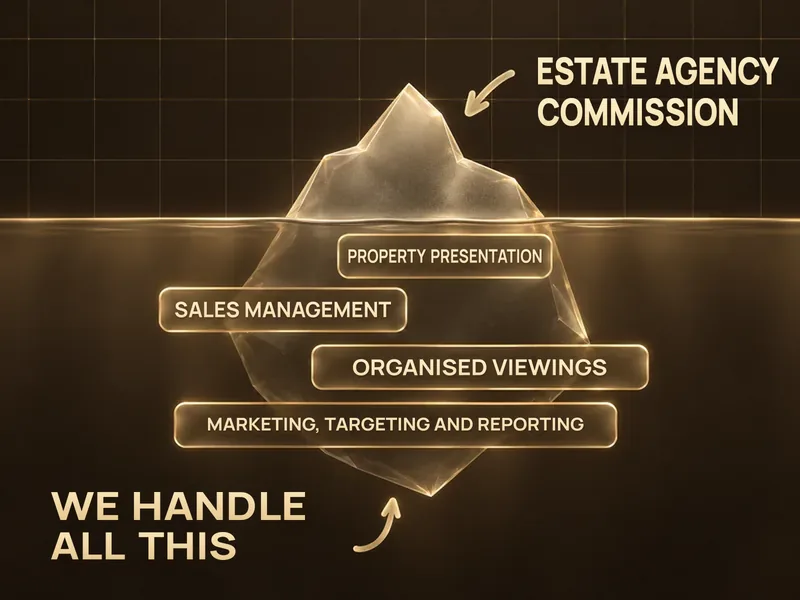
Our commission includes:
- Data to support the price and assess risks
- Presentation through text, photographs and a floor plan
- An advertising campaign with a media plan, creative work, targeting and reporting, including a paid advertising budget of CZK 50,000
- Managing the transaction and communication with interested buyers
- Organised viewings
- Negotiating terms
- Coordinating with the law firm
Read more about how much estate agents charge in commission, how we manage a sale and selling your flat through GATSBYS, including the terms of working with us.
Frequently asked questions
How long does selling a Prague flat take?
There is no substantiated single figure for the whole sale: no official or independent Czech source gives a typical duration from the decision to sell through to receiving payment. Reas reported 122 days for a Prague flat in the spring 2026 season. Registration alone averaged 22 days nationwide in August 2026; Prague’s cadastral office averaged 24 days in 2024.
When will I receive the purchase price?
Your escrow agreement determines the conditions; there is no statutory payment day. A notary releases funds after ownership registration. Registration cannot be approved until 20 days after notice is sent to the owner. For the bank arrangement offered by Komerční banka, release depends on presentation of the documents specified in its purchase price management agreement.
What is the registration fee?
The administrative fee for the registration application is CZK 2,000, payable by whoever submits it.
Do I need an energy certificate to sell?
Usually yes, but not always. You request the PENB from the SVJ or building manager and show it to interested buyers before any agreements are concluded. You then hand it over no later than at signing and state the rating class in the listing. If the certificate is not provided after a written request, you can use the energy bills for the previous 3 years instead. Cultural monuments and buildings in a conservation reserve are exempt. In Prague this mainly concerns the Prague Heritage Reserve, and you need to check the individual building. An older building needs no PENB if it was both constructed and last substantially altered before 1 January 1947 and the parties agree in writing.
Can I sell a flat that has a mortgage?
Yes. In the practice described by Česká spořitelna, the sale needs the bank’s cooperation. The bank provides the balance for a specific date and consents to removal of the lien after repayment. By law, once you give notice of early repayment, the bank must provide a redemption statement and an estimate of compensation. Any compensation is limited to reasonably incurred costs and to the legal caps. If you sell at least 24 months after the loan agreement was concluded, the bank cannot claim compensation. For a fixed-rate period agreed before 1 September 2024, this new regime applies only from the next fixed-rate period.
Will I pay income tax on the sale?
Not if you meet one of the exemption conditions. These apply to a flat in direct ownership that is not part of business assets, where the unit includes no ancillary non-residential spaces other than a garage, a cellar or a storage room. The first condition is having your residence there for at least 2 years immediately before the sale. Alternatively, the income is exempt if you owned the flat for more than 10 years if you acquired it on or after 1 January 2021, or for more than 5 years if you acquired it on or before 31 December 2020. A further option is to use the money for your own housing needs and tell the tax authority in time that you received it. This option is excluded if you acquired the flat before 1 January 2021 and did not have your residence there immediately before the sale. We recommend an individual consultation with a tax adviser.
Must I report a sale above CZK 5 million to the tax office?
An exempt sale of a flat recorded in the Czech Land Register needs no notification of exempt income above CZK 5 million. Where a reporting duty exists and is breached, penalties on unreported income are 0.1% for voluntary late notification, 10% within the additional deadline after a request, or 15% if still unreported. The fine may be waived.
How do I sell a cooperative flat?
You transfer a cooperative share, and registered ownership of the property does not change. The transfer takes effect in relation to the cooperative when it receives the effective agreement, unless the agreement sets a later date. The lease passes with the share, along with debts to the cooperative relating to use of the flat. The transferor is liable for those debts as guarantor. Without registration, there is no 20-day Land Register protection period. Escrow therefore needs a different condition, for example delivery of the agreement to the cooperative. The tax regime is different too, so we recommend consulting a tax adviser.
Must I tell the buyer about defects?
Yes. You must disclose defects you know of while the agreement is being negotiated. The buyer must raise a hidden defect in a structure with a fixed foundation that is permanently attached to the ground within 5 years of acquiring it. After that, the court will not uphold the claim if the seller objects. The seller cannot use this defence if the defect arose from a fact the seller knew of, or must have known of, at handover.
Considering selling a flat or villa in Prague? Get in touch.
Request a sale assessment founder of GATSBYS
Selected for you
-
| Petr Kučera
Estate agent commission: what you pay and what you get
Estate agent commission when selling a flat: understand VAT, included services and extra costs, then compare agency quotes by their final price and scope.
Read -

| Petr Kučera
Buy-to-let flat in Prague: yield, financing and what to check before you buy
Prague buy-to-let flats: gross yields from public data, how to work out your own net yield, CNB investment mortgage limits, tax and checks before you buy.
Read -

| Petr Kučera
Realitka roku: how to use the ranking when choosing an agency
Learn what Realitka roku and Realiťák roku measure, how branch and agent rankings are calculated and how to use them as one factor when choosing an agency.
Read