Selling a mortgaged flat: repayment, escrow and removing the lien
 Written and reviewed by Bc. Petr Kučera, MSc., MBA
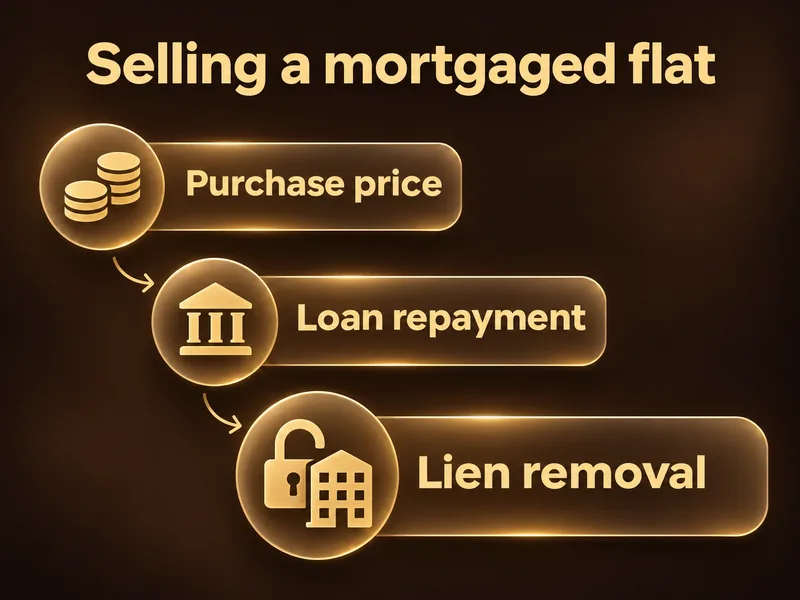
A mortgage lien uses the property as security for a debt. On its own, it does not stop you selling under the legal framework described below. A lien, a prohibition on transfer and a prohibition on further encumbrance are, however, three different legal instruments (Section 1761 of the Civil Code, Act No. 89/2012 Coll.). A good place to start is to separate what is recorded in the Land Register (Cadastre of Real Estate) from what the lender requires under the loan agreement. You can only judge whether a specific restriction applies by reading the Land Register entries and the loan agreement together. The registration of rights and restrictions is explained by the Czech Office for Surveying, Mapping and Cadastre (ČÚZK).
This guide is based on Czech civil and credit law. It covers a flat in direct ownership (a unit registered in the Land Register) used as security for a consumer loan for housing. Its conclusions do not automatically carry over to business loans, co-ownership or SJM (the community property regime of spouses). Cooperative flats have their own rules, which we explain in a separate article on selling a cooperative flat. The legal framework is the Consumer Credit Act together with the Civil Code.
This article reflects the legislation and information available as at 9 November 2026.
What to check before selling a mortgaged flat
Start with documents that help identify a suitable settlement route, taking account of credit rules and Czech National Bank (CNB) guidance.
| Document or source | What to check |
|---|---|
| Loan agreement | The signing date and the loan terms that govern early repayment (Consumer Credit Act) |
| Current fixed-rate period | When the fixed-rate period started and when it ends; for older agreements, also when a new fixed-rate period begins (CNB) |
| Title deed extract (list vlastnictví) | The legal status of the property as recorded in the Land Register: liens and any prohibition on transfer or further encumbrance (Civil Code) |
| Redemption statement | The amount due on the planned payment date; it does not stay valid indefinitely (Komerční banka) |
| Bank requirements | The consents needed and the conditions for releasing the lien (Komerční banka) |
| Intended settlement option | The option you want to discuss with the bank and the documents it will need (Consumer Credit Act) |
These documents help establish your circumstances in the context of the Cadastral Act and the mortgage procedures discussed by Hypoindex. For the wider process, see our guide to selling a flat in Prague.
A lien is not a prohibition on transfer
Under Section 1761 of the Civil Code, a prohibition on transfer or encumbrance binds the contracting parties unless established as a right in rem, which also affects others. Validity conditions include, for example, a specified, reasonable duration and an interest of the relevant party deserving legal protection. The label attached to a registered entry is therefore insufficient to establish the restriction’s effect.
Four possible ways to settle the mortgage
The four options are repayment from the purchase price, repayment from your own funds before sale, the buyer assuming the debt, or replacing the property used as security. MONETA Money Bank and Hypotéka na míru describe possible routes. Availability depends on the lender, contractual terms and security; you are not entitled to approval of all four.
Repaying from the sale proceeds or your own funds
Komerční banka describes using part of the purchase price to repay the loan, or using your own funds before sale. Either way, we recommend asking for a redemption statement for the date you plan to repay. If the money comes from the purchase price, the payment has to follow both the bank’s instructions and the contract terms of the transaction.
The buyer taking over the debt
Assumption of debt means that someone else takes the debtor’s place. When a mortgaged flat is transferred, the law may presume, as between seller and buyer, that the buyer has taken over the secured debt. A presumption is a statutory assumption that a certain state of affairs exists. Your position in relation to the bank is a separate question from the relationship between seller and buyer. The debtor only changes in relation to the bank if the bank consents, or if a statutory procedure creates a presumption of consent (Sections 1888 and 1889 of the Civil Code).
If the plan is to repay the loan, the contract should say so expressly and rule out any unintended assumption of the debt. When you brief your lawyer, make it clear whether the loan is to be repaid or whether the buyer is actually taking over the debt (Section 1888(2) and Section 1889 of the Civil Code).
Replacing the mortgaged property
Replacing the security requires the bank’s consent. It assesses the new property’s value and legal position and may refuse the request. See Česká spořitelna for bank conditions and Section 1901 of the Civil Code for the legal framework. This does not establish a general requirement for an expert valuation report in an ordinary sale; our explanation of price estimates and expert valuation reports distinguishes the terms.
When can your lender charge you for repaying early?
Compensation for costs is the amount the bank may, under statutory conditions, claim in connection with early repayment (Sections 117 and 117a of the Consumer Credit Act). We suggest working through the steps in order. First establish which regime the loan falls under, then check whether your situation qualifies for repayment without compensation. Only after that should you calculate the amount and apply the caps. A percentage on its own is not enough to arrive at a specific figure. This order of steps follows the credit rules and the CNB’s interpretation.
When the new rules apply
According to the CNB, the new rules apply to agreements concluded on or after 1 September 2024. Older agreements with a fixed interest rate move to the new rules with the first new fixed-rate period that starts after 1 September 2024. The earliest such period could begin on 2 September 2024. The original signing date alone may not decide which regime applies.
Transfer after at least 24 months
Under the new regime, the bank may not claim compensation if the statutory conditions for a transfer are met and at least 24 months have passed since the loan agreement was signed (Section 117(3)(e) of the Consumer Credit Act). The period runs from the conclusion of the loan agreement. It is not affected by the date you bought the property or by the last fixed-rate period. With older fixed-rate agreements, the loan must also have moved to the new rules, which happens when a new fixed-rate period begins after 1 September 2024. The CNB explains both the exemption and the regime.
We recommend agreeing the timing of the repayment and the transfer with the bank in advance. A mere intention to sell does not guarantee that you will avoid compensation if you repay before the transfer (Section 117(3)(e) of the Consumer Credit Act).
Other cases without compensation
The situations below come from a CNB overview. Each has its own specific conditions, and you also need to check which regime your loan falls under.
| Case without compensation | Conditions and limits |
|---|---|
| Insurance payout | Only insurance intended to secure repayment of the loan (CNB) |
| Overdraft | A specific form of credit, not an ordinary purpose-bound mortgage (CNB) |
| Period without a fixed rate | The repayment must fall within such a period, not at any time during a fixed-rate period (CNB) |
| Notice of a new interest rate | Repayment within 3 months of the notice under Section 102(3), not within 3 months of just any offer from the bank (CNB) |
| Death, long-term illness or disability | There must be the statutory link to a significant deterioration in the ability to repay; who exactly is covered needs to be checked (CNB) |
| Anniversary repayment | Within one month before the anniversary of the agreement, up to 25% of the total amount of the consumer credit; the base is not the remaining principal, meaning the borrowed amount not yet repaid (Section 117(3)(h) of the Consumer Credit Act) |
| Settling SJM (community property of spouses) | Must relate to the property or right concerned, and at least 24 months must have passed since the loan agreement was signed; not just any property settlement between spouses; the loan regime also matters (CNB) |
How compensation is set and how the old rules differed
The new calculation applies to housing loans under Section 2(2)(b) or (c) of the Consumer Credit Act. Add the necessary administrative costs, capped at CZK 1,000, to the difference between the contractual interest and the reference interest. Only a positive total counts, and the statutory caps still apply, so the administrative maximum is not the whole calculation (Sections 117a and 117 of the Consumer Credit Act).
The reference interest is derived from comparative rates. The CNB publishes average lending rates for groups of comparable housing loans. No single rate, and no single compensation amount, applies to every mortgage.
The CNB overview sets out the percentage caps under the new regime for loans under Section 2(2)(b) and (c). Compensation may not exceed 0.25% of the amount repaid early for each year, or part of a year, left in the fixed-rate period. The overall percentage cap is 1%. These caps apply only outside the situations where no compensation can be claimed, and alongside the other statutory limits. They are upper limits, not an automatic fee.
For the earlier regime, the CNB’s consumer credit overview describes concurrent caps of 1% of the amount repaid early and CZK 50,000 for repayment connected with a sale after more than 24 months. Under the law applicable up to 31 August 2024, only costs reasonably incurred could be claimed, subject to both caps. Check whether your loan still falls within that regime; the CNB’s earlier interpretation explains the cost requirement.
A separate set of percentage caps applies to two other categories of credit: credit other than housing credit, and credit under Section 2(2)(a) that falls under neither (b) nor (c). If more than 1 year of the agreed term remains, the percentage maximum is 1%. If 1 year or less remains, it is 0.5%. The amount of interest and the cases that rule out compensation also limit what can be claimed. These maximums do not apply across the board to every mortgage (Section 117(4) and (5) of the Consumer Credit Act).
Court rulings on earlier legislation
In decision 10 As 26/2025-72 of 30 July 2025, the Supreme Administrative Court (NSS) held that, under the law applicable up to 31 August 2024, the creditor’s interest costs did not qualify as costs reasonably incurred. That conclusion cannot automatically be carried over to the later statutory calculation.
In decision 5 As 246/2024-94, the NSS found that, under the old regime, commissions paid to intermediaries and interest paid to depositors did not count towards the relevant costs. On procedure, the court set aside decision 10 A 30/2022-191 of the Municipal Court in Prague because the lower court had given insufficient reasons for its assessment of whether the penalty for the administrative offence was lawful, leaving that assessment unreviewable. It also required any more favourable later legislation to be considered. The ruling on costs and the procedural outcome of the case are two separate matters.
What to ask your bank
Once you tell the lender that you intend to repay a housing loan early, it must give you a breakdown of the amount owed. It must also state the compensation it expects, with the assumptions behind the calculation, and the other consequences, including situations where no compensation is due. The law requires this ‘without undue delay’ (Section 117(6) of the Consumer Credit Act). This provision sets no general fixed period such as 5 or 10 days.
The statutory information on early repayment must be provided free of charge (Section 90(1) of the Consumer Credit Act). That does not automatically make other bank documents or related steps free as well.
Based on the bank procedures described, we also recommend clarifying the practical details needed for your particular sale.
| Area to clarify | Specific information to obtain |
|---|---|
| Repayment date | The date as at which the bank calculated the amount owed, as explained by Komerční banka. |
| Amount breakdown | The individual components of the required payment, under Section 117(6) of the Consumer Credit Act. |
| Compensation | The bank’s calculation assumptions and whether an exception excluding compensation may apply, under Section 117(6) of that Act. |
| Payment instructions | The destination account and payment method, according to Komerční banka. |
| Consents | The bank’s conditions for the chosen route and any additional security, according to Komerční banka. |
| Document for lien removal | The conditions and process for producing a document suitable for removing the entry, under Section 1379 of the Civil Code. |
Purchase price, escrow and two banks
With escrow of the purchase price, the money is deposited and paid out under conditions set in the contract. The escrow agreement can make the release depend on agreed conditions being met. Depositing the money does not, by itself, change the ranking of liens. Ranking follows the rules on how liens are created and registered, or a separate agreement that changes it (Sections 1371 and 1372 of the Civil Code). Contractual management of the purchase price is described by Komerční banka.
How the repayment money reaches the bank
The part of the purchase price meant to repay the loan has to reach the bank in line with the redemption statement and the payment instructions. It can come straight from the buyer, straight from the buyer’s lending bank, or through escrow. The contract should set out the exact flow of money to match how the purchase is financed. The rules on early repayment do not prescribe a single route for the money (Komerční banka; Section 117 of the Consumer Credit Act).
We recommend that the documentation links the payment to the issue of a document suitable for removing the lien and identifies who will then use that document. The lien ceasing to exist and its entry being deleted from the register are two different events (Section 1378 of the Civil Code).
Temporary security for the buyer’s bank
If the buyer is taking out a new loan, we recommend aligning the two lenders’ requirements early on. Any temporary second-ranking lien for the buyer’s bank must fit the loan and security agreements. Obtain any required consent from the seller’s bank in good time; it has no general statutory duty to consent. See Section 1761 of the Civil Code and MONETA Money Bank’s conditions.
The order of entries generally follows the time the application reaches the relevant cadastral office, with registration taking legal effect from that same moment. Statutory exceptions affecting priority between rights in rem must also be considered. See Sections 9 and 10 of the Cadastral Act and Section 982 of the Civil Code.
What to check in a lawyer’s escrow
According to the Czech Bar Association (ČAK), a lawyer’s escrow (attorney escrow) requires a written agreement adequately identifying the parties, the special account number, amount, currency and precise release conditions. The special account must be designated ‘lawyer’s escrow’ (advokátní úschova).
According to the ČAK and the Ministry of Justice, every lawyer’s escrow of money is recorded in the ČAK Electronic Book of Escrows (Elektronická kniha úschov). The lawyer must report the escrow before accepting the money. One account can hold only one escrow at a time and can be reused only after the previous escrow has been fully settled. These rules cover lawyer’s escrow, and they do not guarantee absolute safety.
Repayment and lien removal are two separate steps
Under the registration procedure explained by ČÚZK, repayment alone does not remove the lien from the title deed extract. After settlement, a suitable document must be obtained and removal completed. Do not assume the bank will submit the application.
Under Section 1949 of the Civil Code, a creditor receiving payment must, at the debtor’s request, issue confirmation that the debt has been discharged, also known as a quittance. Lien removal requires a document whose content is suitable for registration and proves the lien’s extinction under Section 1379. Calling a document a quittance does not establish its suitability for removal.
Who files the application and checks the result
We recommend agreeing in advance who will obtain the document and who will file the application. Afterwards, check that the removal has actually been completed and that the contractual conditions for paying out the rest of the purchase price have been met.
If the buyer is to acquire the flat free of existing liens, make sure every lien concerned both ceases to exist and is removed from the register. Depending on the circumstances, the proof may be a confirmation from the relevant creditor, a court decision or another public document (Section 1379 of the Civil Code).
Several rights belonging to the same creditor may be removed through one application if the rights and properties are properly identified and the necessary documents support every removal. The number of applications and fees depends on the particular submission and supporting documents. See Sections 14(1)(c) and 15 of the Cadastral Act.
Fee, protection period and actual processing time
We recommend distinguishing between the official fee, the protection period and processing time statistics. The figures below come from the Czech Office for Surveying, Mapping and Cadastre (ČÚZK).
| Item | Explanation according to ČÚZK |
|---|---|
| Acceptance of an application | ČÚZK’s fee schedule sets CZK 2,000 for initiating proceedings to register rights in the Land Register, including lien removal. This covers that administrative procedure alone, excluding other sale costs. |
| Conditional electronic filing reduction | Filing through the Land Register Portal attracts a 20% reduction where the conditions are met, bringing the fee to CZK 1,600. ČÚZK’s electronic filing guidance does not extend this to every electronic submission. |
| Protection period | The 20-day protection period runs from dispatch of information to the affected people, according to ČÚZK’s registration guidance. It does not guarantee the overall processing time. |
| Czech Republic statistics | According to ČÚZK’s September statistics for 2026, the average registration time was 22 days, with 67,906 applications submitted and 70,283 processed. These figures cover all registration types. |
Interest deductions in the sale year
An interest deduction reduces the tax base where statutory conditions are met. If a purchased flat is sold during the year, interest on its acquisition loan cannot be deducted for that year, even proportionately, because the full-year ownership condition is unmet. Reducing the annual limit by the number of months in which interest was paid does not replace this condition. See Sections 15(3) and (4) of the Income Tax Act and Brno Regional Court decision 62 Af 18/2024-37.
Assess any deduction for newly acquired housing separately. In the acquisition year, ownership at year end is sufficient for the ownership condition, but the financing loan must relate specifically to that housing need. Buying replacement housing does not restore the deduction for interest relating to the sold flat. See Sections 15(3) and (4) of the Income Tax Act.
If all or part of the housing is used for self-employment or for letting, only a proportionate deduction is possible for the period of that use. This proportionate rule does not remove the ownership requirement for a purchased flat that is sold during the year (Section 15(3) and (4) of the Income Tax Act).
The general limits apply per household whose members share expenses. They are CZK 150,000 for housing acquired on or after 1 January 2021 and CZK 300,000 for housing acquired earlier. The limits do not by themselves create a right to a deduction in the year of sale. General tax rules and limits are set out by the Financial Administration, and the tax side of mortgages is covered by Portál POHODA.
Tax on sale proceeds is separate
Tax on transfer proceeds, notification requirements and interest deductions are separate questions under the Income Tax Act. Settling the mortgage does not automatically resolve them, and the loan itself is no evidence of exemption. Exemption means that, if its conditions are met, you do not have to pay income tax on the income. See the Financial Administration’s information on other income.
The Financial Administration overview distinguishes exemption based on residence from exemption based on how long you have owned the property. The holding period test is 5 years if you acquired the property no later than 31 December 2020. It is 10 years if you acquired it on or after 1 January 2021. You will find more detail in the tax section of our guide to selling a flat.
An exception from reporting exempt income under Section 38v and notification of receiving funds intended for your own housing needs under Section 4b of the Income Tax Act are distinct. Each has its own conditions. See the Financial Administration’s guidance on reporting exempt income.
Where exemption relies on using the proceeds for your own housing needs, you must notify the tax authority of receiving them within the statutory time limit under Sections 4b(2) and (3) of the Income Tax Act. Failure to notify does not itself extinguish the exemption, but may result in a fine. Actual use of the funds and the other exemption conditions remain necessary. See Article IV, point 2 of Act No. 163/2024 Coll. and Section 247a of the Tax Procedure Code.
Cases that need individual assessment
We recommend giving the relevant documents to a lawyer if a transfer or encumbrance prohibition is disputed, debt assumption is unclear, bank conditions conflict, or enforcement restrictions apply. This recommendation is limited to individual assessment and leaves open whether legal representation is mandatory. See the Civil Code and, for enforcement restrictions, the Enforcement Code.
Given the conditions in the tax rules, we recommend individual advice from a tax adviser on interest deductions in the year of sale, financing new housing and the consequences of notifying the receipt of funds for housing needs. The Income Tax Act and Tax Procedure Code provide the substantive, procedural and penalty framework.
Enforcement is not an ordinary lien
Enforcement (exekuce) is the compulsory recovery of an obligation imposed on someone. The obligor (povinný) is the person it is enforced against. Once an enforcement order covers a property, the obligor may not transfer it, encumber it or dispose of it in any other way. Any act in breach of this is invalid, subject to statutory exceptions (Section 47(6) of the Enforcement Code). The ordinary sale procedure therefore cannot be applied automatically.
One possible route is realisation under Section 44a(4) of the Enforcement Code to pay the enforced claim, ancillary amounts, enforcement costs or the enforcement creditor’s costs. Written consent is required from the enforcement officer, the enforcement creditor, meaning the person for whose benefit enforcement takes place, and every creditor who has lodged a claim in the enforcement proceedings. The property must not be subject to another enforcement. The price must be at least the usual value established by an expert valuation report and is payable to the enforcement officer when the agreement is signed. Sections 44a(2) and (3) provide other ways of lifting the prohibition. This special procedure does not create a general valuation-report requirement for ordinary sales.
For enforcement sales in a wider context, see our comparison of property buyout and selling through an estate agency.
Disputing a claim for early repayment compensation
The Financial Arbitrator decides selected financial disputes out of court. Its guidance describes free resolution of credit disputes falling within its jurisdiction.
Before filing, you must ask the creditor to put the matter right. Your application must then include proof that this request did not succeed (Section 10(1)(b) of the Financial Arbitrator Act). A consumer does not have to be represented by a lawyer, either when filing or during the proceedings (Financial Arbitrator: frequently asked questions).
How we handle your sale at GATSBYS
GATSBYS is a Prague estate agency, and in a sale we act for the seller. We assess the likely sale price and identify risks, then prepare the listing text, photographs and a floor plan. Our marketing campaign comes with a media plan, creative, targeting and reporting. We run the sale, deal with interested buyers, organise viewings and negotiate. You can read more about how GATSBYS sells a flat.
We work with sellers under an exclusive brokerage agreement. It runs for 3 months and can be extended if both sides agree. Exclusivity means we are the only agency representing you. For details, see our article on the brokerage agreement and exclusivity.
We coordinate the law firm involved in your sale. Read more in our article on what estate agency commission covers.
Expert commentary
I would start by speaking to the bank. Before agreeing a price and timing with the buyer, I recommend requesting a redemption statement for the planned payment date and checking the bank’s consents and conditions for releasing the lien. Those details provide a sound basis for structuring the purchase agreement and escrow.
Early repayment compensation depends on both the date the loan agreement was signed and the fixed-rate period. I recommend asking the bank for a written breakdown of the compensation and checking it against both your loan agreement and the law.
Paying off the mortgage is not the end of the process, because the registered lien only disappears once it has been removed. I recommend checking that the contract says who will file the application, which document the bank will issue and on what conditions the escrow will be released. If enforcement is involved or there is a dispute over compensation, I would have a lawyer look at it before you sign.
Petr Kučera, founder of GATSBYS
Frequently asked questions
Does the buyer take over the loan automatically?
When a mortgaged flat is transferred, the law may presume, as between the parties, that the buyer has taken over the secured debt. In relation to the bank, however, the debtor only changes with the bank’s consent, or through a statutory procedure that creates a presumption of consent. If the plan is to repay the loan, the contract has to be set up accordingly (Sections 1888 and 1889 of the Civil Code).
When does the 24-month period for the transfer exemption start?
The 24 months run from the signing of the loan agreement. The statutory conditions for a transfer must also be met and the new regime must apply. For older fixed-rate agreements, the deciding point is a new fixed-rate period starting after 1 September 2024. A plan to sell is not enough on its own to guarantee that you can repay before the transfer without compensation (Section 117(3)(e) of the Consumer Credit Act). See the CNB’s explanation.
How much can I repay without compensation before the anniversary?
Within one month before the anniversary of the agreement, you can repay up to 25% of the total amount of the consumer credit without compensation. The base is the total amount of the credit, not the principal still outstanding. You also need to check which credit regime your loan falls under (Section 117(3)(h) of the Consumer Credit Act).
Must the bank provide early repayment information free of charge?
Yes. Once you tell the bank that you intend to repay a housing loan early, it must give you the statutory repayment information free of charge and without undue delay. The law does not set a fixed number of days. The rule does not automatically cover every other bank document (Section 117(6) and Section 90(1) of the Consumer Credit Act).
Is confirmation of repayment enough to remove the lien?
What counts is what the document says and whether it is legally suitable. A document called a confirmation that the debt has been paid is not guaranteed to work for removal. Depending on the circumstances, the end of the lien can be proven by a confirmation from the creditor, a court decision or another public document (Sections 1949 and 1379 of the Civil Code).
Can one application remove several rights held by the same creditor?
Yes, provided the rights and properties are properly identified and suitable documents support the removals. The number of applications and fees must be assessed against the particular documents. See Sections 14(1)(c) and 15 of the Cadastral Act.
Can I deduct acquisition-loan interest proportionately in the sale year?
For a purchased flat sold during the year, no acquisition-loan interest deduction is available for that year, even proportionately, because the full-year ownership condition is not met. Replacement housing requires separate assessment and does not restore the old flat’s deduction. See Sections 15(3) and (4) of the Income Tax Act and Brno Regional Court decision 62 Af 18/2024-37.
Do I need a lawyer for proceedings before the Financial Arbitrator?
Consumers do not need a lawyer to apply or during proceedings, according to the Financial Arbitrator. You must first ask the lender to remedy the matter and attach evidence that the request failed, as required by Section 10(1)(b) of the Financial Arbitrator Act.
The Czech legal framework described reflects the Civil Code, Consumer Credit Act and Income Tax Act as at 9 November 2026. Have your individual contract assessed by a lawyer and your tax circumstances by a tax adviser. When you sell through GATSBYS, we coordinate the law firm.
Considering selling a flat or villa in Prague? Get in touch.
Request a sale assessment founder of GATSBYS
Selected for you
-

| Petr Kučera
Selling a flat in Prague
Selling a flat in Prague, from preparing documents to receiving payment: Land Register, escrow, PENB, SVJ confirmation, mortgage, tax and cooperative flats.
Read -

| Petr Kučera
Estate agent commission: what you pay and what you get
Estate agent commission when selling a flat: understand VAT, included services and extra costs, then compare agency quotes by their final price and scope.
Read -

| Petr Kučera
Buy-to-let flat in Prague: yield, financing and what to check before you buy
Prague buy-to-let flats: gross yields from public data, how to work out your own net yield, CNB investment mortgage limits, tax and checks before you buy.
Read