How to choose an estate agency
 Written and reviewed by Bc. Petr Kučera, MSc., MBA
When you sell your flat, you want to know who will handle negotiations with prospective buyers, documents and pricing decisions. Drawing on the Real Estate Brokerage Act (Act No. 39/2020 Coll.) and guidance from ARK ČR (the Czech association of estate agencies), we recommend checking authorisation, insurance, evidence of results, the service offered and contractual commitments.
Use documentary evidence to assess whether an agency suits your sale. Legal requirements, documented sales and voluntary awards play different roles in your choice. The steps below are designed to help you compare specific proposals (see the Trade Licensing Act (Act No. 455/1991 Coll.) and the National Register of Qualifications).
The legislation cited reflects the provisions in force on 12 November 2026.
Who signs the agreement, and who will handle your sale?
In the Czech Republic, real estate brokerage is a regulated trade requiring professional competence under Annex 2 to the Trade Licensing Act. Check authorisation first, then assess service quality using the steps below.
Distinguish the business named in your agreement from the people carrying out the relevant activities. Under Section 7(6) and Annex 5 to the Trade Licensing Act, the business must ensure those people are professionally competent. Its responsible representative oversees the professional conduct of the trade but does not replace that duty. Several qualification routes are available; a single particular professional examination is not compulsory for everyone.
Brokers must also meet a statutory good-character requirement concerning their criminal record. For a legal entity, this extends to its beneficial owner, the relevant individuals on its statutory body, representatives of legal entities serving on that body and people in equivalent positions. The statutory body acts for the company. Section 5 of the Real Estate Brokerage Act does not make an agent’s entire personal history publicly accessible.
The Trade Licensing Register and the limits of ARES
Record your contractual partner’s name and business identification number (IČO). In the official Trade Licensing Register, check for the specific trade authorisation ‘Realitní zprostředkování’ (real estate brokerage).
ARES, the Administrative Register of Economic Entities, describes the data it shows as informative. For official proof, you need an extract from the relevant register.
Ask to see the insurance certificate
The basic minimum insurance limits are CZK 1,750,000 per insured event and CZK 3,500,000 per year. Section 7(1) and (2) of the Real Estate Brokerage Act set these limits; the Act permits a reduction only under specific conditions.
Section 7(5) allows a 50% reduction where the broker has a written agreement with another legal entity carrying out real estate brokerage. The broker must act exclusively in that entity’s name, or in their own name while unmistakably using its business name or brand. If lower limits apply, we recommend asking to see that agreement.
On request, the broker must present the insurance certificate confirming that an insurance contract has been concluded. Where reduced limits apply, they must also show the agreement with the relevant other legal entity. Section 8 of the Real Estate Brokerage Act distinguishes this certificate for the prospective client from the insurance contract submitted to the ministry.
According to the Public Administration Portal, brokers must submit their insurance contract to the Ministry for Regional Development (MMR) within 10 working days of concluding it.
Insurance is a statutory condition of operating. Failure to arrange it can attract a fine of up to CZK 1,000,000 under Section 21 of the Real Estate Brokerage Act.
Ask for verifiable results with comparable properties
ARK ČR recommends several years’ practice and local knowledge, including prices achieved. We suggest asking for specific completed sales of similar properties in a comparable micro-market: an area with similar conditions.
What the Land Register can and cannot show
The Czech Office for Surveying, Mapping and Cadastre (ČÚZK) says the Land Register (Cadastre of Real Estate) does not publish aggregate sale-price overviews. For a particular property, its viewing service, Nahlížení, shows whether a price record exists. You can then purchase that information through Remote Access for Unregistered Users.
According to ČÚZK, price records have been kept since 1 January 2014. Reports are organised by individual registration proceedings.
A publication by the Institute of Sociology of the Czech Academy of Sciences, citing ČÚZK, notes that a price record may cover several properties transferred together. To verify the price of one flat, check the document that transferred ownership, such as the purchase agreement.
ČÚZK’s Remote Access service provides Land Register records and documents for individual properties and proceedings. We recommend checking an agent’s transactions individually, matching price records against documented listings. For aggregate results, ask for the full list of properties the agent was hired to sell and how they calculated their results.
Making sense of sale times and sale-to-asking-price ratios
Research published by Springer examines how pricing, seller and agent characteristics, and market conditions relate to the likelihood of selling above asking price. Alongside the research context from ScienceDirect, we recommend assessing sale times and price ratios in light of the market, pricing strategy and mix of cases.
If the achieved price stays the same, a lower initial asking price produces a higher ratio. A US study published by Springer in 2020 associated underpriced listings with a greater likelihood of selling above asking price. Its data covered 2001 to 2015: 116,129 listings, of which 101,641 resulted in transactions.
A study from Massachusetts in the USA, published through ScienceDirect, highlights the need to measure the total time on the market. Using only the final listing can omit earlier unsuccessful attempts. The study does not establish how common relisting is in the Czech Republic or its effects here.
The table below is our own recommendation for comparing results. It draws on research published on ScienceDirect and by Springer.
| Area to clarify | Information needed for comparison |
|---|---|
| Number of completed sales | Size of the original sample |
| Property mix | Types of property and locations included |
| Basis of the price ratio | Whether the first or final asking price is used |
| Start and end of measurement | What exactly the reported time to sell covers |
| Relisting | Whether earlier listings count |
| Properties that did not sell or were withdrawn | Whether and how they are included |
An overseas study published by Springer examined agency listing volumes and results. Higher volumes were associated with higher prices, smaller discounts and less time on the market.
A study published by Alan Yelowitz examined sales from 1 January 2001 to 30 November 2008 in one large US Midwestern city. Greater recent activity among individual sellers’ agents was associated with faster sales and lower prices. Read this separately from the Springer study: the markets differ, as does the unit measured, individual agents rather than agencies.
With studies from abroad, check which market and which population they cover. Percentage effects found under a different registration and contract system, such as those reported via ScienceDirect and EconPapers, should be tested against Czech data before you apply them to a flat in Prague.
Ask the agent to explain an unusually high price recommendation
If a proposed price is markedly higher, ask for comparable completed sales and an explanation of differences, drawing on ARK ČR. Knight’s US research, available at Wiley and through ResearchGate, associates large percentage changes in asking price with longer sale times and lower final prices.
Rightmove cited experience from the British market in April 2025 suggesting that a higher starting price may be used to test interest. The same source said that such listings received markedly fewer requests for viewings.
According to Wiley, the available abstract of Knight’s study was published on 17 December 2002. The study covers changes to the asking price in both directions.
Another study, published in 2017 with a version dated 19 March 2016, appears through ResearchGate and Springer. Its authors suggest deliberately high recommendations to win instructions as one possible explanation for overpricing.
Distinguish the gap between average asking and achieved prices from the discount on a particular flat. Valuo compares average advertised prices with actual prices. The REALIndex from Broker Consulting is based only on completed transactions.
To learn more about price terms and how prices are moving, read about the difference between a price estimate and an expert valuation report and property price trends and outlook.
Compare services by what they actually deliver
We recommend comparing proposals using one checklist, drawing on the Real Estate Brokerage Act and ARK ČR guidance. This is a selection tool, rather than a compulsory service specification for every agency.
| Area to compare | Details to check |
|---|---|
| Identity and responsibility | Contractual partner, IČO and person carrying out the work |
| Authorisation and insurance | Trade authorisation, insurance certificate and any evidence supporting reduced limits |
| Results and references | Comparable completed sales and verifiable references |
| Price | Evidence supporting the proposal and explanation of comparability |
| Listing materials | Specified deliverables and examples |
| Distribution | Channels and extent of promotion |
| Managing the instruction | Named person responsible and their duties |
| Documents and completion | Legal services, escrow, documentation and handover |
| Costs | What the commission covers and separately charged items |
| Communication | Progress reports and action if the plan is not met |
| Contract terms | Exclusivity, duration, extensions and termination |
Drawing on the Real Estate Brokerage Act and MMR, we also recommend comparing handover arrangements and related documents.
Check the marketing plan and communication
Section 3 of the Real Estate Brokerage Act lists advertising among usual activities. We recommend agreeing the quality of photographs and video, number of channels and advertising budget in the contract.
Ask for examples of previous work, the preparation process, the distribution channels, how you will be kept informed and what the agent will do if few offers come in. For the presentation, our own checklist covers photography, video, a floor plan, a virtual tour, the listing text and preparing the interior. For distribution, it covers property portals, other channels, buyer databases and paid promotion. The contract should list what the commission includes. The framework for this comes from the law and the ARK ČR code of ethics.
For more on comparing fees, see our article on estate agency commission.
Weigh references, certifications and awards separately
ARK ČR recommends positive client references, preferably from someone you know whose judgement you trust. It recommends treating references published on the agent’s own website with appropriate caution.
A professional qualification under Act No. 179/2006 Coll. is one of several ways to prove the competence the regulated trade requires. The alternatives are set out in the annexes to the Trade Licensing Act, and a related provision is Section 24 of the Real Estate Brokerage Act.
The National Register of Qualifications contains a qualification standard for estate agents with the code 66-042-M. It has been valid since 20 May 2025 and has no end date set. The authorising body is the MMR. The standard tests legal knowledge, technical assessment of properties for brokerage, marketing tools, the brokerage activities themselves and setting the asking price.
The Czech Society for Quality runs a voluntary certification called ‘Certifikovaný realitní makléř’ (Certified Estate Agent). Applicants must document 20 transactions and show relevant education and experience. They also need a client reference and a case study, and they must pass a written and an oral exam. They must complete 100 hours of training, which relevant university study can replace.
Under ARK ČR’s membership conditions, an agent’s individual membership does not automatically cover their agency unless it is itself a full member. Check the agency’s own full membership against ARK ČR’s membership framework.
Public sources gave different figures for ARK ČR’s size as at 12 November 2026.
| Source | Agencies stated | Agents stated |
|---|---|---|
| ARK ČR website | More than 300 | No number of agents given in this figure |
| ARK ČR profile on LinkedIn | More than 400 | Approximately 3,000 |
A statutory qualification, a voluntary certification and a competition each assess different things against different standards. The relevant sources here are the National Register of Qualifications, the Czech Society for Quality and Realiťák roku (a Czech estate agent competition). For each one, find out what it actually measures. Read more on how to interpret the competition rankings.
What the available surveys actually show
According to the commissioning organisation’s Seznam publication, STEM/MARK surveyed 609 property-website users online from 21 September 2022 to 27 September 2022. Results published on 27 February 2023 ranked a positive previous experience first, followed by online reviews. Presentation and agency size also mattered. This was not a representative sample of Prague sellers.
A separate ČESKÉREALITY.cz article, published on 24 May 2019, described a poll of 685 participants commissioned by a property services provider.
| Participants’ answer | Published share |
|---|---|
| The individual agent’s reputation and results matter more than the agency brand | Over 71% (ČESKÉREALITY.cz) |
| They want the agent to be a certified valuer | Over 68% (ČESKÉREALITY.cz) |
| Membership of a professional body is important | More than half (ČESKÉREALITY.cz) |
| Brand visibility is important | 6% (ČESKÉREALITY.cz) |
| Print media and agency catalogues are a valuable source of information | 10% (ČESKÉREALITY.cz) |
ČESKÉREALITY.cz reported participants’ preference for an agent who was also a certified property valuer. Section 24 of the Real Estate Brokerage Act does not make that combination a general legal requirement.
Before signing, compare what you were promised with the contract
The brokerage agreement sets out how you will work with the agency. Under Section 9(2) of the Real Estate Brokerage Act, it must be in writing.
The agreement must state what is being brokered and the commission or the method for working it out. Where the real estate contract to be arranged is for consideration, the agreement must also state the price or how it will be set, which in a sale means the purchase price. The law treats rent and other consideration in a similar way. If the subject or the consideration is not yet known, it can be agreed at least in general terms. The exact service you will get can only be found in the contract’s own provisions. These rules are in Section 10 of the Real Estate Brokerage Act.
A Czech Trade Inspection Authority (ČOI) case from 2012, before the Real Estate Brokerage Act, concerned an arrangement presented orally as non-exclusive despite penalties for selling without the broker. Our recommendation is to compare what you are told with the actual wording.
The checks below are our recommendations, drawn from the law described above and from that historical case.
| Situation to investigate | What to check |
|---|---|
| Refusal to show the insurance certificate | Duty to present it on request under Section 8 of the Real Estate Brokerage Act |
| Unclear identity or authorisation | Business identity and specific trade authorisation in the Trade Licensing Register |
| Unsupported proposed price | Comparable completed sales and reasoning, following ARK ČR guidance |
| Assurances conflict with the agreement | Actual duties and penalties, in light of the ČOI case |
| Unclear service, commission or responsibility | Contractual scope and commission calculation under Section 10 |
| Active promotion of the broker’s own escrow | Compliance with restrictions in Section 4 of the Real Estate Brokerage Act |
What exclusivity means for your sale
Under Section 17(1) of the Real Estate Brokerage Act, exclusivity limits your freedom to engage another agent for the same property. It also limits your freedom to conclude the real estate contract without the cooperation of the agent you signed with. As a result, selling the property yourself to a buyer you have found is restricted as well.
In this context, a consumer is a private seller acting outside any business. With a consumer, exclusivity can only be agreed for a fixed period of no more than 6 months. Each extension, including repeated ones, can be agreed no earlier than 30 days before the current period ends. Choose the actual length within that limit to suit your sales plan. The legal basis is Section 17(4) of the Real Estate Brokerage Act.
Weigh the restrictions you accept against the specific commitments you get in return. Check the marketing approach and the rules for ending the agreement.
The published abstract of a 2026 study, available on EconPapers, uses data from a large firm in Beijing. It associates exclusivity with a higher chance of selling within 90 days and a faster sale. The abstract does not report higher asking or transaction prices. The authors attribute the effect to agents organising more viewings.
Find out whether other agents can be brought in and on what terms. The ARK ČR code of ethics requires members to cooperate where this is in the client’s interest, with respect for collegiality and good working relations. We recommend agreeing this in the contract for your listing.
Clearly assigned responsibility may make activity easier to monitor, while exclusivity restricts your freedom as a seller. Drawing on Section 17, Section 19 of the Real Estate Brokerage Act and ARK ČR, we recommend clarifying what happens if the agent is inactive.
Read more about contract terms and exclusivity.
Check termination, commission and escrow arrangements
By default, commission falls due no earlier than the conclusion of the real estate contract. An earlier due date is possible only if the agreement tells you that the commission does not depend on the contract being concluded or on a condition precedent being met. A condition precedent is an agreed circumstance on which the contract taking effect depends. Even with an earlier due date, payment can fall due no sooner than the moment the agent secures the opportunity to conclude the contract. For consumers, any advance is capped at two thirds of the commission. The legal basis is Section 19 of the Real Estate Brokerage Act.
Under Section 19(4), the broker has no right to demand commission from a consumer if the contract triggering entitlement to commission is concluded only after the brokerage has ended because the broker’s inactivity, failings or insufficient cooperation delayed its conclusion. Mere dissatisfaction is insufficient: those timing and causal conditions must apply.
Section 18 caps the notice period at one month for a consumer agreement of indefinite duration. It does not automatically allow every fixed-term agreement to be ended on that basis.
Escrow means an agreed arrangement for holding the purchase price and the conditions for releasing it. An agent must not actively offer its own escrow. It may arrange escrow with a bank, a notary or a lawyer. A foreign bank qualifies if it operates in the Czech Republic through a branch. A court enforcement officer qualifies only in connection with enforcement, court or other proceedings. The legal basis is Section 4 of the Real Estate Brokerage Act.
An agent may hold the money in its own escrow only if the client asks in writing in a separate document. Other statutory conditions must also be met. These include a written escrow agreement, a separate account for each depositor, proper records and cashless transfers only. The written request alone is not enough. The legal basis is Section 4 of the Real Estate Brokerage Act.
Section 11 of the Real Estate Brokerage Act sets out who must receive an extract from the public register. The extract goes to the client who is acquiring ownership or a right of use. The duty applies where the brokered property, or the property it forms part of, is entered in a public register such as the Land Register. The extract must normally be handed over no later than the day the brokerage agreement is concluded. It must show the position no more than 3 working days before that day. If the extract is not provided as Section 11 requires, the client may withdraw from the agreement within 14 days of its conclusion. Where the subject is described only in general terms under Section 10(2), a separate deadline for handing over the extract applies under Section 12(2).
If penalties, escrow or termination are unclear, or if the text contradicts what you were told, we recommend a legal review before you sign. This follows from Sections 4, 17 and 19 of the Real Estate Brokerage Act and from the ČOI case.
Questions to ask the agency at a meeting
Before comparing proposals, gather details of the contractual partner, their authorisation and who will do the work, along with insurance evidence, transaction records and a draft agreement. Our recommendation draws on the Trade Licensing Act, Section 8 of the Real Estate Brokerage Act and ARK ČR guidance.
These questions help you assess and verify proposals. The specific statutory right identified here concerns insurance documents on request under Section 8; ARK ČR informs the wider recommendations.
| Question to ask | What the meeting should establish |
|---|---|
| What is your IČO, and who will carry out the work? | Clear identification of the contractual partner and individual |
| Can I see the insurance certificate and any agreement supporting reduced limits? | Documents that must be presented on request by law |
| Which similar properties have you actually sold, and when? | Specific comparable completed transactions |
| What supports your proposed price? | Evidence and an explanation |
| How do you define your reported results? | Methodology for time, price ratios and selection of cases |
| What does the service include, and what costs extra? | Defined deliverables and costs |
| How will you present and market my property, and how will you keep me updated? | Examples, channels and reporting arrangements |
| What happens if the plan is not met or offers are scarce? | Further steps and responsibility |
| Who provides legal services and escrow? | Named providers and contractual arrangements |
| Can other agents participate? | Any conditions governing cooperation |
The questions on legal services, escrow and cooperation follow Section 4 of the Real Estate Brokerage Act and the ARK ČR code of ethics. The list does not mean that every commission covers all of these items.
Depending on your situation, you can continue with the complete process for selling a flat in Prague, selling a flat with a tenant in place, tax rules when selling a property or the transfer of a cooperative flat into direct ownership.
Apply the same checks to the service we offer at GATSBYS
At GATSBYS, our Prague estate agency represents sellers of flats and villas, with sales limited to Prague.
We use an exclusive brokerage agreement with the seller for 3 months, extendable by mutual agreement. We charge buyers no commission.
Our service includes a data-based assessment of pricing and risks. For the presentation, we prepare the text, photographs and a floor plan. The campaign includes a media plan, creative work, targeting and reporting. During the sale, we manage the instruction, deal with prospective buyers, run the viewings and negotiate the terms. For the legal side, we coordinate with a law firm.
See our guide to estate agency commission for fee details.
If something goes wrong
Start by working out what the problem concerns. Supervision is split between authorities according to the type of obligation.
| Area of duties | Responsible authority and scope |
|---|---|
| Sections 4 and 5 of the Real Estate Brokerage Act, including escrow and good character | Municipal trade licensing authorities, under Sections 20 to 22 of that Act |
| Insurance under Section 7(1), (2) and (4) | MMR, under Sections 20 to 22 of that Act |
| Consumer Protection Act | ČOI, which does not supervise compliance with the Real Estate Brokerage Act |
This division of supervision does not give trade licensing authorities general oversight of every contractual requirement (see also the ČOI case). We recommend a lawyer’s assessment of specific contractual uncertainties.
Historical examples and the limits of what they tell us
Reports from 2018 published by Parlamentní listy (a Czech news website) and attributed to dTest (a Czech consumer organisation) described complaints about unreturned reservation fees and incorrect price or commission information. A 2020 report in Parlamentní listy described payments received without entitlement and poor service quality.
The 2018 reports in Parlamentní listy, attributed to dTest, also described photographs and descriptions used without the owner’s agreement, and inactivity after exclusivity was agreed. In 2018, Euro described agents posing as ordinary prospective buyers and taking photographs for subsequent brokerage without the owner’s knowledge. We recommend checking that the owner knows about and consents to the brokerage.
In a reply dated 26 February 2025, ČOI provided a set of 19 cases in which it had sanctioned estate agencies under consumer protection law. The period ran from 2020 until the request was processed.
In a statement reported by e15 on 19 February 2026, a ČOI spokesperson gave a different figure, referring to several dozen consumer reports about agencies and agents each year. This was a media account without a precise reference year or separate statistical table. Reports are distinct from inspections, sanctions and cases in Prague.
Complaints and amicable settlement
Under ARK ČR’s procedure, complaints against members go to its secretariat. After an attempt at amicable resolution, the Supervisory Board may consider the matter. The association does not handle non-members’ cases or disputes it knows are being dealt with in court.
A 2018 report attributed to dTest, published by Parlamentní listy, described VašeStížnosti.cz as offering free help in reaching an amicable settlement. Check the current terms with the operator.
Expert commentary
For me, the most important thing when choosing an estate agency is knowing exactly who will be selling your flat. The sale rests on the agent you will be in contact with under whatever reporting arrangement you agree.
At the first meeting, I would want to see documented sales of similar flats and the reasoning behind the proposed price. I would treat a high estimate without supporting evidence as a warning sign.
Before signing, I would check the length of exclusivity, the notice terms and the commission. I would make sure that what was promised verbally matches the contract. I would also ask for proof of insurance and professional competence.
Petr Kučera, founder of GATSBYS
Frequently asked questions
Must the individual agent be professionally competent?
Yes. Real estate brokerage is a regulated trade. Under Section 7(6) and Annexes 2 and 5 to the Trade Licensing Act, the business must ensure that people actually performing the relevant activities are competent. A responsible representative does not replace that duty. Several qualification routes are available, rather than one compulsory examination.
Can I ask to see the insurance certificate?
Yes. The agent must show you the insurance certificate on request. If the limits are reduced, the agent must also show you, on request, the agreement that supports this arrangement. The legal basis is Section 8 of the Real Estate Brokerage Act.
Do all agents have the same insurance limits?
No. The basic minima are CZK 1,750,000 per insured event and CZK 3,500,000 annually. A 50% reduction requires a written agreement with another legal entity conducting real estate brokerage. The broker must act exclusively in its name, or in their own name while unmistakably using its business name or brand. Brand affiliation alone is insufficient. Under Sections 7 and 8, you can request the agreement supporting this arrangement.
Must the brokerage agreement be in writing?
Yes, the brokerage agreement must be in writing under Section 9 of the Real Estate Brokerage Act. It must state what is being brokered and the commission or how it will be calculated. In a sale, it must also state the purchase price or how that price will be set. If the subject or the consideration is not yet known, it can be agreed at least in general terms, as Section 10 of the Real Estate Brokerage Act allows.
How long can exclusivity with a consumer last?
It can only run for a fixed period of no more than 6 months. Repeated extensions are possible, and each one can be agreed no earlier than 30 days before the current period ends. Six months is a maximum, not a required length, so match the length to your sales plan. The rule is in Section 17(4) of the Real Estate Brokerage Act.
Does exclusivity also cover a buyer you find yourself?
Yes, exclusivity affects your own sale as well. It restricts you from concluding the real estate contract without the cooperation of the agent you signed with, and that includes selling the property yourself to your own buyer. The legal basis is Section 17(1) of the Real Estate Brokerage Act.
Can an agency actively offer its own escrow service?
No, it cannot actively offer one. An agent may provide its own escrow only if the client asks in writing in a separate document and other statutory conditions are met. These include, in particular, a written agreement, a separate account for each depositor, proper records and cashless transfers. The request alone is not enough. The rules are in Section 4 of the Real Estate Brokerage Act.
Does a one-month notice period apply to every agreement?
No. A notice period of no more than one month applies only to a consumer agreement concluded for an indefinite period. It gives no automatic right to end a fixed-term agreement in the same way. The legal basis is Section 18 of the Real Estate Brokerage Act.
The cited Real Estate Brokerage Act and Trade Licensing Act provisions reflect the law in force on 12 November 2026. Have a lawyer assess your individual agreement. When you sell through GATSBYS, we coordinate with a law firm.
Considering selling a flat or villa in Prague? Get in touch.
Request a sale assessment founder of GATSBYS
Selected for you
-
| Petr Kučera
Selling a flat in Prague
Selling a flat in Prague, from preparing documents to receiving payment: Land Register, escrow, PENB, SVJ confirmation, mortgage, tax and cooperative flats.
Read -
| Petr Kučera
Estate agent commission: what you pay and what you get
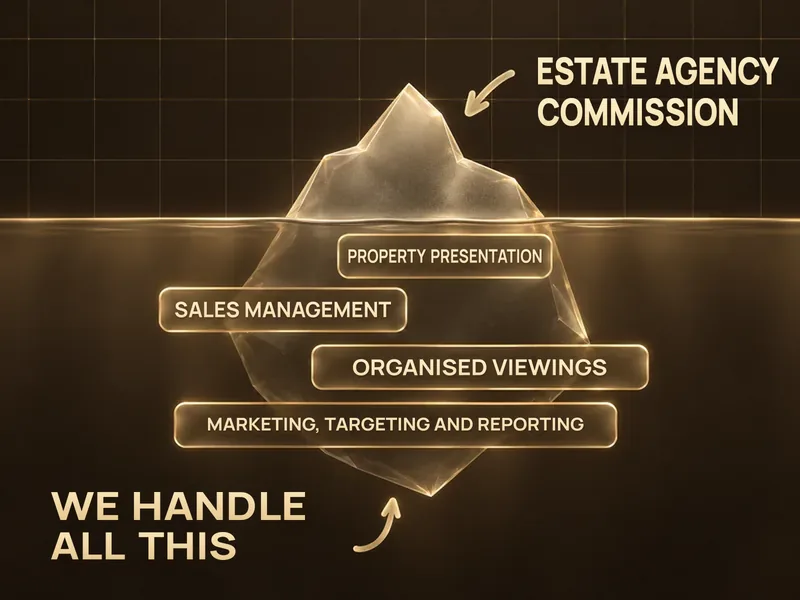
Estate agent commission when selling a flat: understand VAT, included services and extra costs, then compare agency quotes by their final price and scope.
Read -

| Petr Kučera
Buy-to-let flat in Prague: yield, financing and what to check before you buy
Prague buy-to-let flats: gross yields from public data, how to work out your own net yield, CNB investment mortgage limits, tax and checks before you buy.
Read