Market price, agent’s estimate or expert report: which do you need?
 Written and reviewed by Bc. Petr Kučera, MSc., MBA

Before comparing figures, we recommend establishing what is being valued, the valuation date and the purpose. Valuation relates to a specific date and assumptions under Section 2 of Act No. 151/1997 Coll. The purchase price, by contrast, is what the parties agree in an individual transaction.
An agent’s proposal, a bank valuation and an expert valuation report answer different questions under Section 3 of the Real Estate Brokerage Act (Act No. 39/2020 Coll.), Section 28 of Act No. 254/2019 Coll. and Section 113 of the Consumer Credit Act (Act No. 257/2016 Coll.). Before comparing them, we recommend checking that they cover the same property, date and valuation method. Different purposes often explain different figures, but each result still needs a documented process. Section 2 of Act No. 151/1997 Coll. also underpins this distinction.
The legal texts and data in this article reflect the position as at 9 November 2026.
Market price, usual price and market value
We recommend distinguishing between the price you expect the flat to sell for, the asking price you want to advertise, and the valuation procedures defined by law (Sections 1 to 2 of Act No. 151/1997 Coll.; see also Section 3 of Act No. 39/2020 Coll.). Whenever a document is labelled ‘market price’, we recommend asking its author what exactly they mean by it.
Usual price (obvyklá cena, the price normally paid in comparable sales) is a statutory category based on ordinary commercial dealings in the Czech Republic on the valuation date. It is determined by comparing prices actually agreed, excluding exceptional market circumstances, either party’s personal circumstances and special attachment, meaning the property’s particular personal significance. Current asking prices cannot replace the agreed prices required by this definition. The basis is Section 2(2) of Act No. 151/1997 Coll.; the consolidated wording applicable at the article’s reference date took effect on 1 January 2025.
Market value (tržní hodnota) is defined by law as the estimated amount for which an asset could be exchanged as at the valuation date. It assumes a willing buyer and a willing seller acting independently of each other, proper marketing, and neither party acting under duress (Section 2(4) of Act No. 151/1997 Coll.).
Why a statutory valuation may give a different figure
The determined price (cena zjištěná), a price calculated under the statutory valuation rules, is a legal category of its own, separate from both the usual price and market value. The law sets a different method for arriving at it. The resulting figure may differ from the other two, but it may also turn out the same (Section 2(7) and (9) of Act No. 151/1997 Coll.).
Section 2(7) of Act No. 151/1997 Coll. defines it directly: ‘A price determined under this Act otherwise than as the usual price, extraordinary price or market value is the determined price.’
Where the Valuation Decree (Decree No. 441/2013 Coll.) applies, the determined price must also be established alongside the usual price or market value of a property. The exception covers valuing collateral for purposes related to the activities of a bank, a foreign bank or a savings and credit cooperative. This applies to the wording effective from 1 January 2026 (Section 1c(1) to (2) of Decree No. 441/2013 Coll.). The rule does not automatically extend to every private estimate made for a sale.
Online estimate, agent’s estimate, bank valuation or expert valuation report
We suggest starting with the questions below. These are recommendations for comparing outputs, not a list of every provider’s statutory obligations.
| Output | Question to ask | How to interpret its limits |
|---|---|---|
| Online estimate | What inputs were used, and against what reference was error measured? | Professional guidance recommends understanding the specific model’s evidence and validation: European Valuer. |
| Agent’s estimate | Is this an achievable sale price or a recommended initial asking price? | By law, brokerage usually includes assessing the property’s condition and proposing an asking price: Section 3(2)(b) of Act No. 39/2020 Coll. |
| Bank valuation | Which value was used, and for what purpose? | Valuing loan security serves a different purpose from agreeing a purchase price. This provision alone does not determine the loan amount: Section 113(3) of Act No. 257/2016 Coll. |
| Expert valuation report | What are the instructions, purpose and valuation date? | The report must be complete, truthful and clear enough for its reasoning and conclusions to be checked: Section 28 of Act No. 254/2019 Coll. |
We recommend checking which property features an online model actually includes. For example, one Czech provider’s currently available methodology describes an indicative flat price range that does not account for condition, floor level or a lift.
Drawing on a 2018 paper published by TEGoVA, we recommend assessing the result of a model that works without a viewing alongside a description of its inputs and validation, meaning how the model was tested.
What to ask your estate agent
Under Section 3(2)(b) of the Real Estate Brokerage Act (Act No. 39/2020 Coll.), in the wording effective from 1 July 2021, real estate brokerage usually includes assessing the condition of the property and proposing its asking price.
For comparison, we recommend asking separately for the estimated achievable sale price and the recommended initial asking price. This reflects the distinction between valuation and an offer in Sections 1 to 2 of Act No. 151/1997 Coll. and Section 3(2)(b) of Act No. 39/2020 Coll. Those provisions do not establish a duty to supply two figures.
For more on comparing agency arrangements, see our guide to the brokerage agreement.
Why a bank valuation may differ from the purchase price
Property securing consumer credit for housing serves as security for the loan. Section 113(3) of Act No. 257/2016 Coll., in the wording effective from 1 September 2024, requires usual price or market value under the Property Valuation Act as the valuation basis. The valuation must be impartial, objective and recorded. This provision alone defines neither every type of bank valuation nor the loan amount.
The Capital Requirements Regulation (CRR) governs regulatory valuations of property collateral. From 1 January 2025, prudential criteria exclude expected future price growth and cap the valuation at the market value that can be determined. This is not a universal definition of bank valuations. Transitional arrangements apply to older exposures, meaning previously incurred credit risks: Articles 229(1) and 495f of CRR, as amended by Regulation (EU) 2024/1623.
The rules for securing a loan and the agreement on a purchase price serve different purposes (Section 113(3) of Act No. 257/2016 Coll.; the CRR as amended by Regulation (EU) 2024/1623). How the loan is settled when you sell is covered in our article on selling a flat with a mortgage.
Requirements for expert valuation reports
An expert valuation report is a professional output subject to statutory requirements: completeness, truthfulness and reviewability, so its conclusions and underlying data can be checked. If the evidence or method prevents an unambiguous conclusion, the expert must identify circumstances reducing accuracy. See Section 28(1) and (5) of Act No. 254/2019 Coll., effective from 1 January 2026, and the Ministry of Justice.
If a report refers to International Valuation Standards (IVS), distinguish their existence from a duty to use them. According to the International Valuation Standards Council (IVSC), the new edition was published on 31 January 2024 and took effect on 31 January 2025. Those dates alone do not make IVS mandatory for every Czech valuation.
In 2026, the Ministry of Justice published methodological communication No. 1/2026 on IVS. Its existence alone does not establish a general obligation to use IVS.
When is an expert report needed?
The Property Valuation Act itself does not require an expert report before agreeing the price of a privately owned flat, because price negotiation falls outside its scope: Section 1(2) of Act No. 151/1997 Coll. This conclusion cannot automatically be extended to special proceedings, property regimes or contractual requirements.
An estate, meaning the assets dealt with after a death, is subject to its own succession proceedings. The Notarial Chamber of the Czech Republic explains that an expert report is not automatically needed in every case. We recommend discussing the required valuation evidence with the notary handling the proceedings. The legal framework is Sections 180 to 181 of Act No. 292/2013 Coll., in the wording effective from 1 January 2026.
The Notarial Chamber of the Czech Republic states that a report ‘is in any event not an automatic requirement of every succession proceeding’. It may nevertheless be needed in an individual case.
For an out-of-court settlement of spouses’ joint property (SJM), the law generally does not require an expert report. Property settlements involving real estate do require a written agreement and the corresponding registration in the Land Register (Cadastre of Real Estate): Sections 736 to 742 of the Civil Code (Act No. 89/2012 Coll.), effective from 1 January 2026.
In court proceedings, an expert is appointed when the statutory conditions are met, particularly where a professional opinion is insufficient because of complexity or there are doubts about its correctness. See Section 127 of Act No. 99/1963 Coll., in the wording effective from 1 November 2026.
For court settlement of SJM terminated under the Civil Code, the usual price and the property’s condition at the time of the court’s decision generally apply: Supreme Court, 22 Cdo 1205/2019, R 103/2020.
The age of a report should also be assessed in light of its purpose. For court dissolution and settlement of co-ownership by shares, where several people own specified shares, the cited case law requires a report used to determine adequate compensation to be updated two years after preparation, or sooner where circumstances warrant. This is not a universal two-year validity period: Supreme Court, 22 Cdo 652/2025, paragraphs 22 to 24.
If a report is unclear or incomplete, or the court doubts its correctness, the court first asks the expert for an explanation. If that does not resolve matters, it requests supplementation or review by another expert: Section 127(2) of Act No. 99/1963 Coll.
If price is disputed in court settlement of SJM or co-ownership, we recommend discussing the evidence needed with a lawyer (attorney), taking account of the purpose and proceedings. This is neither a general duty to have legal representation nor an automatic requirement for an expert: Section 127 of Act No. 99/1963 Coll. and Supreme Court case law.
Before commissioning a report, the Ministry of Justice recommends checking the expert’s entry in the official register. Confirm that the assignment matches their field, branch and any specialisation.
Special transfers have their own rules
Assess the following situations separately from an ordinary voluntary sale of a flat.
| Special situation | Legal rule and its limits |
|---|---|
| Non-cash contribution to a limited liability company (s. r. o.), meaning assets contributed instead of money | By default, the contribution is valued by an expert from the official register. The law also refers to exceptions that apply by analogy and require individual assessment (Section 143 and Sections 468 to 473 of Act No. 90/2012 Coll., wording from 19 July 2024). |
| Listed transfers of state property for consideration to an eligible municipality or region | The relevant organisational unit of the state sets the purchase price on the basis of an expert report at the usual price or, if that cannot be determined, at the determined price. The costs of the report, the geometric plan and the energy performance certificate (PENB) are added. This applies only to the transfers listed in Section 21c(1) (Section 21c(1) to (2) of Act No. 219/2000 Coll., wording from 1 January 2026). |
| Special transfers of municipal property defined in subsection 1 | The municipality sets the usual price on the basis of an expert report. If the usual price cannot be established, it sets the determined price instead. It adds the costs of the report, the geometric plan and the PENB (Section 39c(1) to (2) of Act No. 128/2000 Coll., wording from 1 January 2026). |
| Insolvency, meaning proceedings concerning a debtor’s insolvency | The insolvency administrator commissions an expert valuation of the collateral where the right to satisfaction of a filed claim from the collateral has been asserted. The administrator also commissions a valuation of the assets being realised when proceeding under Section 290 or Section 292. The cost limitation in subsection 3 applies accordingly, and subsection 5 is taken into account (Section 219 of Act No. 182/2006 Coll., wording from 1 January 2026). |
| Transfers between persons connected as defined by law | Being connected does not in itself create an obligation to obtain a report. The tax base is adjusted by the difference if two conditions are both met. First, on the sale of a property, the price agreed between the connected persons differs from the price that unconnected persons would agree under the same or similar conditions. Second, the difference is not satisfactorily documented. A report may serve as evidence (Section 23(7) of Act No. 586/1992 Coll., wording from 1 August 2026). |
| Enforcement, meaning the forced enforcement of an obligation | According to the information portal of the Ministry of Justice, an enforcement sale follows its own formal valuation procedure. That procedure cannot serve as a model for an ordinary voluntary sale. |
For more context, see our article on property buyouts and related questions.
How much an expert valuation report costs: private or regulated fee
Distinguish a privately agreed contractual fee from regulated expert remuneration, the non-contractual fee determined by legislation. There is no single fixed market price for privately commissioned reports. See Section 31 of Act No. 254/2019 Coll., in the wording effective from 1 January 2026.
The non-contractual hourly rate is CZK 800 to 1,000 per hour under Section 2(1) of Decree No. 504/2020 Coll. The Ministry of Justice links the increase to 1 January 2023. This rate matches the wording as at 1 January 2026; it is not the total price of a privately commissioned report.
For a report you commission privately, we recommend asking for a specific contractual quotation. We do not recommend treating the hourly rate above as a price list for an entire private report: Section 31 of Act No. 254/2019 Coll.
How to recognise a well-founded estimate for a Prague flat
Even the highest figure should be assessed alongside its evidence. Under the Valuation Decree’s regime for usual price and market value, data must be checkable and the processing method clear and documented: Decree No. 441/2013 Coll. This does not impose expert-report requirements on every agent’s proposal.
The rules on usual price and market value in Sections 1a to 1c of Decree No. 441/2013 Coll. were introduced from 1 January 2021 by Decree No. 488/2020 Coll. The current consolidated version of the Valuation Decree took effect on 1 January 2026.
The questions below are our practical GATSBYS checklist for comparing valuations, informed by Decree No. 441/2013 Coll., Act No. 151/1997 Coll. and Act No. 39/2020 Coll. They are not a list of statutory duties applying to every estate agent.
| Area to check | Question for the valuation’s author |
|---|---|
| Purpose | What decision is this intended to support? |
| Date | What is the valuation date? |
| Type of prices | Are these completed sales or asking prices? |
| Data source and age | Where did the data come from, and how current are they? |
| Comparability | Why was each transaction selected? |
| Adjustments | How were differences between properties accounted for? |
| Limits | What cannot reliably be concluded from the evidence? |
When determining usual price under the Valuation Decree’s procedure, data on at least three similar properties are required, using agreed prices for comparison. If usual price cannot be determined through that procedure, the inability must be documented. This minimum does not automatically apply to every agent’s estimate or every market value assessment: Section 1a(1) to (4) of Decree No. 441/2013 Coll.
Why price per square metre is not enough
For a more expensive or unusual Prague flat, we recommend treating the average price per m² for the whole of Prague or for a city district only as a rough guide. This recommendation draws on the comparative method: base the estimate on similar properties that have sold and take account of how they differ (Section 1a of Decree No. 441/2013 Coll.).
According to the Czech Office for Surveying, Mapping and Cadastre (ČÚZK), one recorded price may cover several properties transferred together. Before dividing it by a single flat’s floor area, check everything included in the transfer. Make the same check when using that transaction later as a comparable.
Czech methodological and research materials distinguish transactional data in the Land Register, aggregate statistics from the Czech Statistical Office (ČSÚ) and bank datasets covering only part of the market. Interpretation must account for selection, reporting delays and the availability of price-relevant characteristics. A national average alone cannot value an individual Prague flat. See also the Institute of Sociology of the Czech Academy of Sciences.
The discussion above concerns transactions recorded in the Land Register. According to ČÚZK, cooperative share transfers fall outside that scope. See selling a cooperative flat.
Asking price versus the agreed sale price
The Czech National Bank (CNB) and ČSÚ distinguish the seller’s asking price from the price agreed in a completed transaction. Differences between averages for different periods or samples do not, by themselves, establish negotiated discounts on the same flats. Each figure needs its own period and sample definition.
A historical commercial analysis covering Czech regions illustrates why first and final asking prices matter. According to the analysis, its sample comprised 3,887 listings linked to sales, from 1 January 2021 to 31 March 2022.
| Comparison within the historical sample | Result reported by the analysis |
|---|---|
| All included properties, against the final asking price | Sale price averaged 0.92% lower: historical commercial analysis, the source for this table. |
| Flats only, against the final asking price | Sale price averaged 0.29% lower. |
| Flats only, against the first asking price | Sale price averaged 1.06% lower. |
| Flats and houses advertised for fewer than 14 days | Sale price averaged 1.00% higher than the final asking price. |
| Flats and houses combined, advertised for at least 181 days | Sale price averaged 3.23% lower than the final asking price, approximately 3%. |
In this historical commercial analysis, how long a property was advertised was associated with the gap between the realised price and the last asking price. The finding applies to flats and houses assessed together.
International research suggests a higher asking price may be associated with a longer expected selling period: see the study of asking prices and time on the market. Related work from Harvard Kennedy School and a study of asking-price strategy also challenges an automatic inference of lower final proceeds.
A 2003 study by Anglin, Rutherford and Springer states that ‘an increase in the list price increases expected time-on-the-market’.
When interpreting the Czech commercial analysis and the international research discussed by Harvard Kennedy School, allow for the fact that advertising duration, price changes and the outcome may also be linked to the property’s characteristics and market conditions.
What does an online estimate’s claimed accuracy mean?
Research findings depend on method, sample and period: see studies of Czech price data, houses in and around Ostrava and valuation models in Oslo.
The European Valuer, No. 22, pages 24 to 25 offers professional guidance on what to ask about a model. Its May 2021 issue reproduces the recommendations from Matysiak’s 2018 report. These recommendations do not create a Czech legal obligation for providers of online valuations.
| Indicator recommended by European Valuer | What to check |
|---|---|
| Confidence intervals | Are 50% and 95% confidence intervals provided for the result? |
| Number of comparable properties | How many comparables were used? |
| Geographical distribution | Where are the comparable properties? |
| Age of sales | What are the dates of the oldest and newest comparable sales? |
| Accuracy measurement | Which metrics were used, and was error measured against sale prices or other valuations? |
The examples below report different research findings. The Czech study of bank estimates did not test automated valuation models (AVMs).
| Research source and sample | Finding | Limits of applicability |
|---|---|---|
| Czech study published in 2022 (Institute of Sociology of the Czech Academy of Sciences), 2019 data, 5,495 pairs of similar flats linking bank valuations with ČÚZK purchase prices | In 3,314 pairs, the valuation per m² was higher than the purchase price per m² of the matched flat: 60.3% according to the study, roughly 60% | Pairs of similar flats, not identical transactions and not a test of AVMs |
| Endel, Teichmann and Kutá, 2020, article 7774: a specific method applied to 122 completed sales of detached family houses in and around Ostrava | The calculated price was within 10% of the sale price in about 80% of cases | Limited to that method, that type of house and the sample of 122 sales |
| Study in the 2026 volume: 164,619 flat transactions in Oslo from 2008 to 2022, with a randomly separated test set of 41,155 observations | Combining XGBoost, comparable sales and linear least absolute deviations produced MdAPE of 5.17%; XGBoost alone produced 5.24%. MdAPE means median absolute percentage error. | Validates only these models on this Oslo test set |
| Matysiak’s 2017 conference paper on automated valuation models, using published data from a single US portal covering 666 US counties | Table 2 gives an average of county median percentage errors of 6.0%, with county medians ranging from 3% to 25% | A summary of county medians from one portal in those 666 counties |
What you can find in the Land Register and limits on publishing it
According to ČÚZK, Nahlížení do katastru, the Land Register viewing service, identifies properties with a recorded price and the relevant proceedings. The amount itself is available for a fee to unregistered users through Dálkový přístup, the remote-access service. See the viewing service’s help page.
According to ČÚZK documentation, price records have been kept since 1 January 2014.
The fee for an official output depends on the applicable item in the fee schedule. The rates below follow the wording of the decree from 1 July 2024, in force as at 9 November 2026 (Section 11(7) and Annex 4 of Decree No. 358/2013 Coll.).
| Type of official output | Fee and limits (Decree No. 358/2013 Coll.) |
|---|---|
| Price data in PDF or HTML, item 4021 | CZK 50 per output, for up to 200 properties of the same type |
| Price data in PDF or HTML, item 4022 | CZK 50 per output |
| Certified output or duplicate of a document from the collection of deeds, item 4020 | CZK 20 for each A4 page or part of one, capped at CZK 300 |
These ČÚZK fees cover specified official Land Register outputs, not an individual valuation.
Public access to price data does not automatically authorise republication. Dissemination is subject to Section 53 of the Cadastral Act (Act No. 256/2013 Coll.) and Sections 11a and 15a to 15c of Decree No. 358/2013 Coll. Converting a price to a figure per m² does not itself make publication lawful. The Act’s wording took effect on 1 October 2025; the Decree’s on 1 July 2024.
How pricing fits into preparing a sale with GATSBYS
We are a Prague estate agency and represent the seller in a sale. We use market data to recommend an asking price and identify risks.
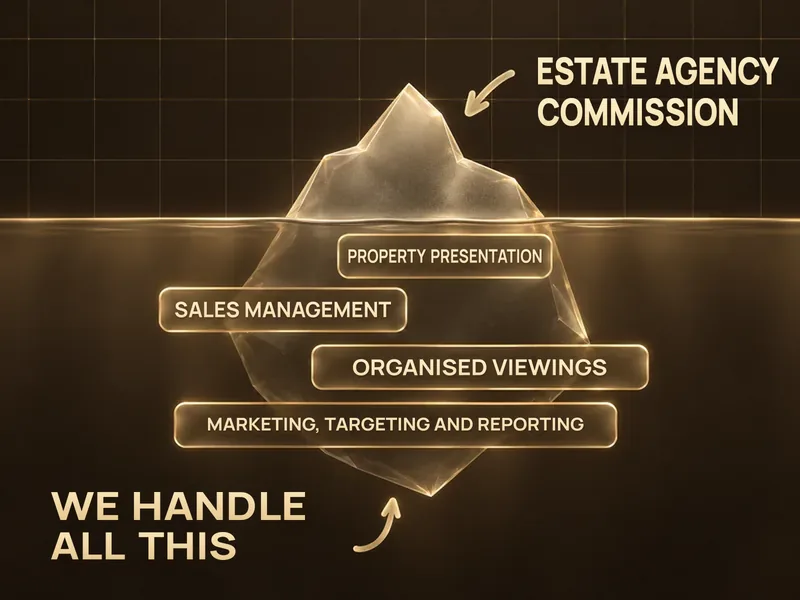
We prepare the presentation: the text, photographs and floor plan. We run the marketing campaign, which covers the media plan, creative work, targeting and reporting. We handle communication with interested buyers, manage the viewings and negotiate the terms. When you sell through GATSBYS, we also coordinate the work of a law firm.
The further steps are summarised in our guide to selling a flat in Prague. Commission and what it covers are explained in a separate article on estate agency commission.
Expert commentary
I start by asking what you need the figure for. An agent’s proposal, a bank valuation and an expert report answer different questions. I would want to know their dates and underlying evidence before comparing the amounts.
With an agent’s estimate, I want to see what supports it: comparable completed sales, when they took place and how those properties differ from your flat. A figure per square metre or advertised asking prices alone cannot stand in for an actual sale price.
I would commission an expert report where required by law, a court or another specific purpose. For an ordinary sale, I would first ask who wants it and why. If price is disputed, for example when settling spouses’ joint property or co-ownership, I would discuss the evidence with a lawyer.
Petr Kučera, founder of GATSBYS
Frequently asked questions
How is a property’s usual price determined?
It is determined by comparing prices agreed in ordinary commercial dealings in the Czech Republic as at the valuation date. Exceptional market circumstances, the personal circumstances of the parties and special attachment are excluded. Current listings on their own cannot replace the agreed prices that the legal definition requires (Section 2(2) of Act No. 151/1997 Coll.).
Must the determined price differ from the usual price?
No. Different legal categories can lead to the same figure (Section 2(7) and (9) of Act No. 151/1997 Coll.).
Does real estate brokerage by law include proposing an asking price?
Under Section 3(2)(b) of Act No. 39/2020 Coll., brokerage usually includes assessing the condition of the property and proposing its asking price.
What must an expert report provide?
It must be complete, truthful and clear enough for its reasoning and conclusions to be checked. If the evidence or method prevents an unambiguous conclusion, the expert must state what limits accuracy: Section 28(1) and (5) of Act No. 254/2019 Coll.
Does every estimate require at least three comparable properties?
No. The usual-price procedure in Section 1a(1) to (4) of Decree No. 441/2013 Coll. requires at least three similar properties and comparison of prices actually agreed. If usual price cannot be determined this way, that inability must be documented. The minimum does not automatically extend to every agent’s estimate or every market value assessment.
Is every expert report valid for two years?
No. The cited Supreme Court ruling concerns updating a usual-price report for adequate compensation in court dissolution and settlement of co-ownership by shares. An update is required after two years, or sooner if circumstances warrant: Supreme Court, 22 Cdo 652/2025, paragraphs 22 to 24. This is not a validity period for all reports.
What does a court do with an unclear or incomplete report?
The court first asks the expert for an explanation. If that does not resolve matters, it requests supplementation or arranges review by another expert. The same sequence applies where the court doubts the report’s correctness: Section 127(2) of Act No. 99/1963 Coll.
The legal context is Czech legislation as at 9 November 2026. A lawyer assesses your specific agreement and a tax adviser assesses your tax circumstances. When you sell through GATSBYS, we coordinate the law firm.
Considering selling a flat or villa in Prague? Get in touch.
Request a sale assessment founder of GATSBYS
Selected for you
-

| Petr Kučera
Selling a flat in Prague
Selling a flat in Prague, from preparing documents to receiving payment: Land Register, escrow, PENB, SVJ confirmation, mortgage, tax and cooperative flats.
Read -
| Petr Kučera
Estate agent commission: what you pay and what you get
Estate agent commission when selling a flat: understand VAT, included services and extra costs, then compare agency quotes by their final price and scope.
Read -

| Petr Kučera
Buy-to-let flat in Prague: yield, financing and what to check before you buy
Prague buy-to-let flats: gross yields from public data, how to work out your own net yield, CNB investment mortgage limits, tax and checks before you buy.
Read